


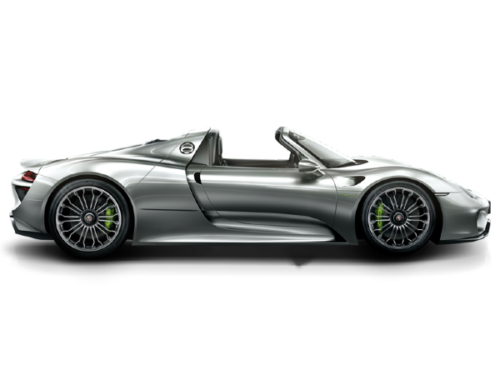
The Story of the Porsche 918 Spyder – Ultimate Guide
Introduction
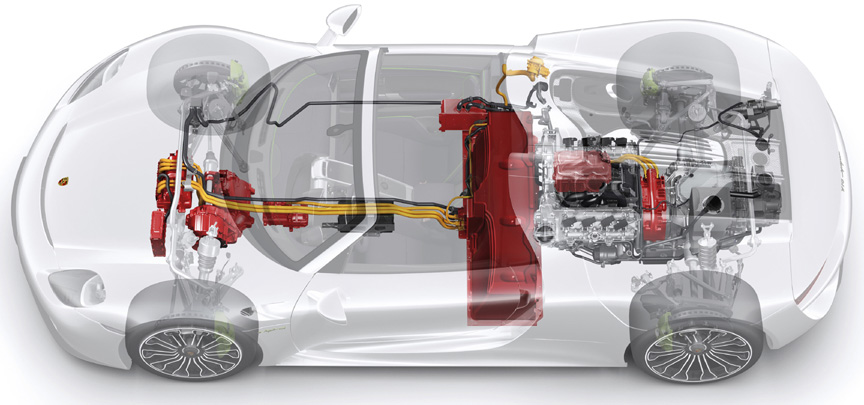
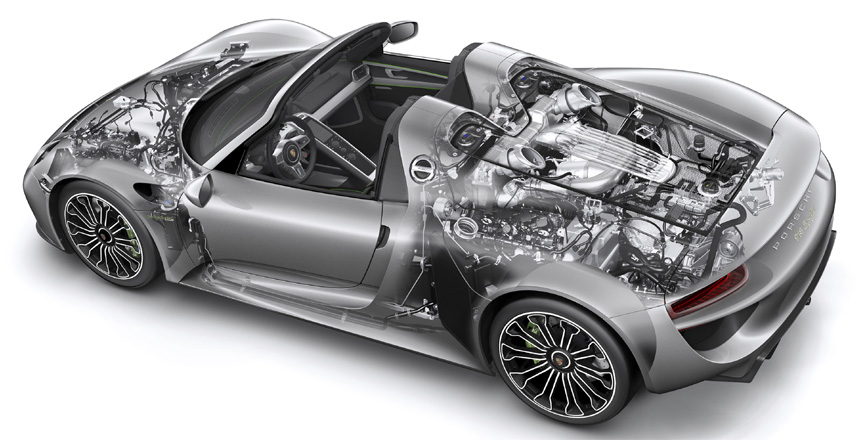
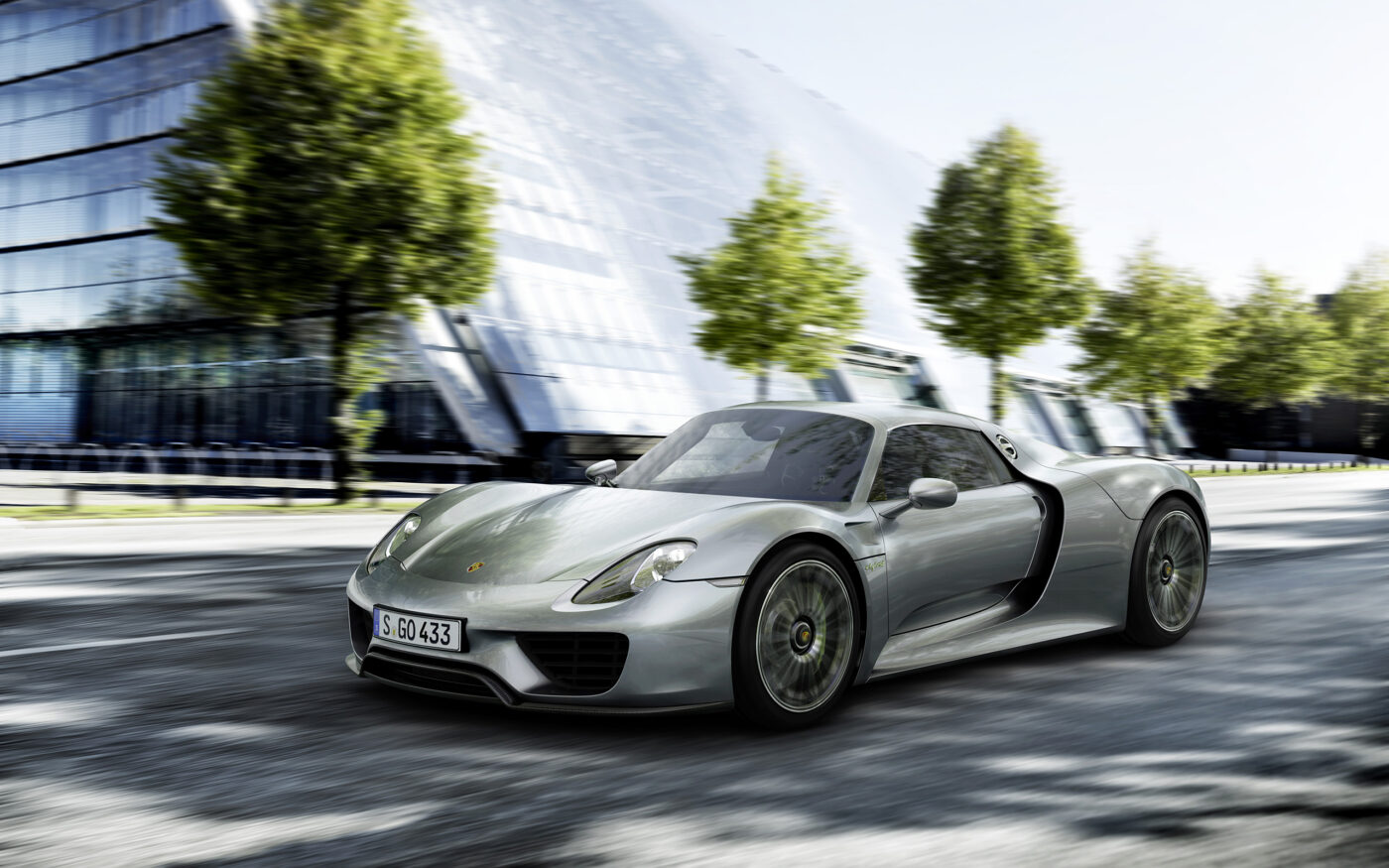
Simply stated, the Porsche 918 Spyder was a mid-engined, plug-in hybrid supercar. The Spyder was powered by a naturally-aspirated 4.6-liter V8 engine that was capable of producing 608 horsepower (453 kW). Paired with this engine are two electric motors that deliver an additional 279 horsepower each, for a cumulative combined total of 887 horsepower (661 kW.) Production on the Porsche 918 began on September 18, 2013, with the brand’s first deliveries scheduled to begin in December 2013. Each car had a starting price of $845,000 (U.S.), yet the Spyder sold out quickly in December, 2014. Production of the brand ended entirely in June, 2015. In an independent series of speed tests performed by Car and Driver Magazine, the Porsche 918, achieved a 0-62 mph (0-100 km/h) of just 2.6 seconds, a 0-100 mph (0-161 km/h) time of 4.9 seconds and a 0-180 mph (0-290 km/h) time of just 17.5 seconds. It is one of the fastest accelerating cars on the planet and its top speed is up there too with the fastest cars in the world.
- Concept car premiere: 2010 March 2, Geneva motor show (Salon international de l’automobile de Genève)
- Production car premiere: 2013 September 10, IAA Frankfurt Motor Show
- Market launch: 2013 November
- Important Note: All the 918 had 2015 model year VIN, even the cars produced in 2013.
A Brief History
The work of 100 Weissach technicians, who developed the 918 Spyder concept car, received deserved honour on July 28, 2010, when the supervisory board of Porsche AG decided to develop the concept car into series production car. 8 pilot vehicles for testing different components aswell as 25 prototypes were made. Michael Drolshagen was appointed as the director of the 918 production. On March 21, 2011 Porsche started taking orders and on September 18, 2013 making of the first production 918 started. 918 was produced at the Porsche’s main factory in Stuttgart (for comparison, the Carrera GT was produced in Leipzig, with only the engine made in Stuttgart). The last, 918th, order was taken in November 2014 for the car to be finished by the middle of 2015. Of the 918 cars 297 were ordered for USA. Buyers both in Germany and in China ordered around 100 cars.
Porsche’s list of supercars is rather small, with the Porsche 959, the Carrera GT, and the 911 GT1 the only true “supercars” Porsche has made. Just like the Porsche 959 aimed to do in the 1980s, the Porsche 918 was designed to show just how far todays technology could be pushed in a car. The 918 Spyder was all about using the most cutting-edge, advanced technology and electrification ideas to build the first true “hypercar”. First show in 2010 as a concept and launched for the 2013 model year, the 918 Spyder was a landmark hypercar for the industry; the 918 is considered the first hybrid hypercar, and is credited with partially inspiring the current wave of high-performance hybridization sweeping through the industry.
The 918 Body
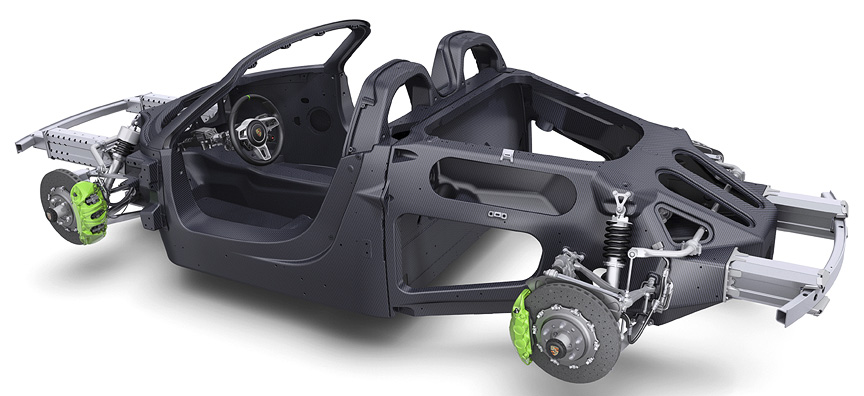
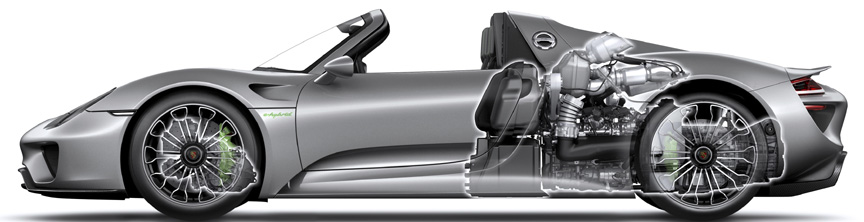
The Spyder’s body is fully made of carbon fibre reinforced plastic (CFRP) and has a two-piece Targa roof. The car has a 43/57 weight distribution.
Rear-Axle Steering
The hybrid system’s batteries and electric motors made the 918 Spyder relatively heavy for a sports car and to make it agile, the rear-axle steering system was created. It comprises an electro-mechanical adjustment system on both rear wheels. The adjustment is speed-sensitive and executes steering angles up to 3 degrees in both directions. At low speeds, the system steers the rear wheels in the opposite direction to the front wheels – this makes cornering easier and reduces the turning circle. At higher speeds, the system steers the rear wheels in the same direction as the front wheels and the car virtually changes lanes sideways. It is more complicated when power sliding as then the ground speed is not high, but the rear wheels should steer at the same direction with the front wheels.
Petrol Engine and Top Exhaust Pipes
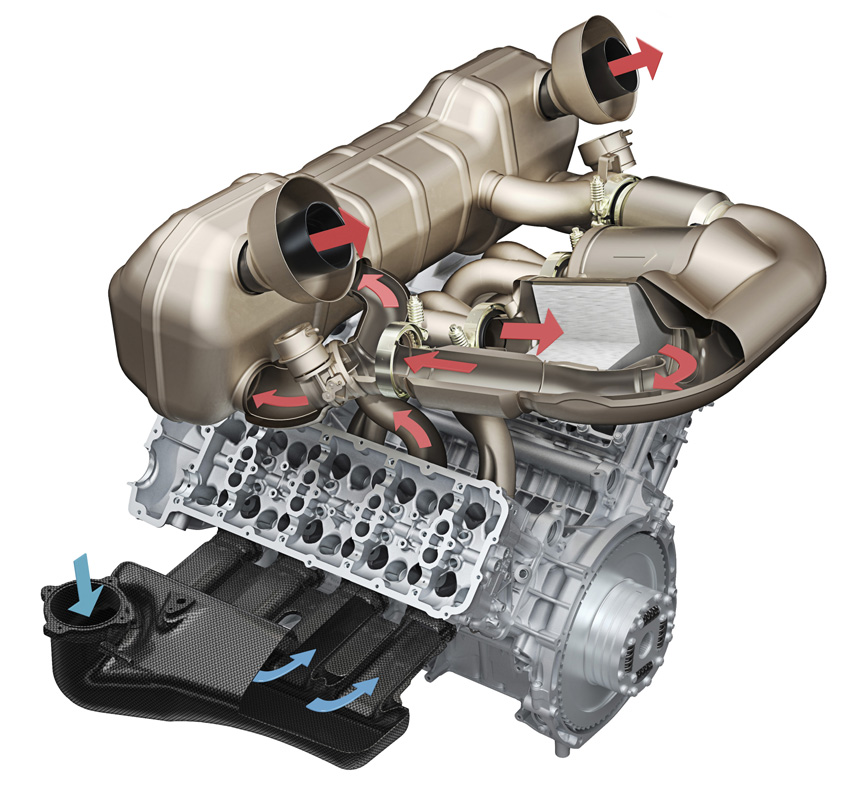
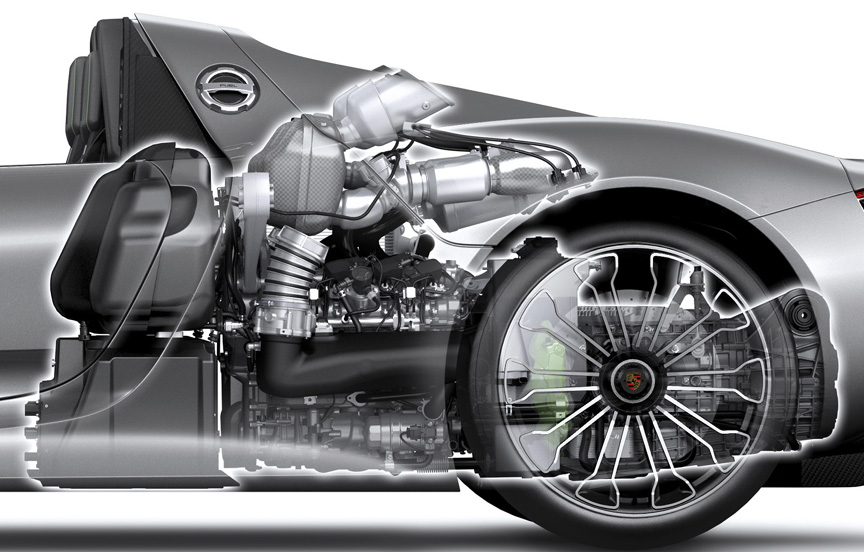
In contrary to the 2010 concept car where the exhaust pipes exited in the sides, the pipes of the production model exit just above the engine. The top pipes’ greatest benefit is that the hot exhaust gases are evacuated as quickly as possible and the exhaust gas back pressure remains low. This design required a new, thermodynamic air channelling concept: the exhaust manifolds are located inside in the cylinder V and the intake tracts are outside. There’s a further benefit: the engine compartment remains cooler. Just that when filling the car at the gas station, extra care has to be taken into account as the fuel filler neck is not too far from the hot exhaust pipes.
Weissach Package
With this package the weight was added by rear side fins and 6-point harnesses, but reduced thanks to many features, including:
- magnesium wheels (minus 14.9 kg/32.8 lb). The wheels were in the same sizes as the ones on the standard car: 9.5×20″ in front with 265/35 tyres and 12.5×21″ at the rear with 325/30 tyres.
- film-coating instead of body paint (minus 2.3 kg/5 lb)
- lighter brake system (minus 2.0 kg/4.4 lb)
- titanium chassis bolts (minus 0.8 kg/1.7 lb)
- ceramic wheel bearings (minus 0.7 kg/1.5 lb)
- less sound isolation
- deleted Speed Charging onboard equipment
- deleted automatic function for AC
- deleted Burmester sound system
In total the package shaved off up to 41 kg/90 lb (from 1675 kg/3692 lb to 1634 kg/3602 lb). Parts of the interior were upholstered with Alcantara instead of leather, and visible CFRP replaced much of the aluminium. The frame of the windscreen, roof, mirror housings and rear wing were also of visible carbon fibre reinforced plastic. The Weissach package costed about 10% on top of the car price, which meant you could get another Porsche for it.
Weight
With the concept car the announced target weight for the production car was under 1490 kg /3285 lb. This was not achieved. It was the same with the Carrera GT – the target weight was 1250 kg, but the finished car weighed 1380 kg. The engine capacity was increased in order to keep up with the higher weight. With the 918 the initial weight target was 1490 kg and the V8 had 3.4-litre capacity. The production car weighed at least 1634 kg and the new 4.6-litre engine was needed.
Electricity
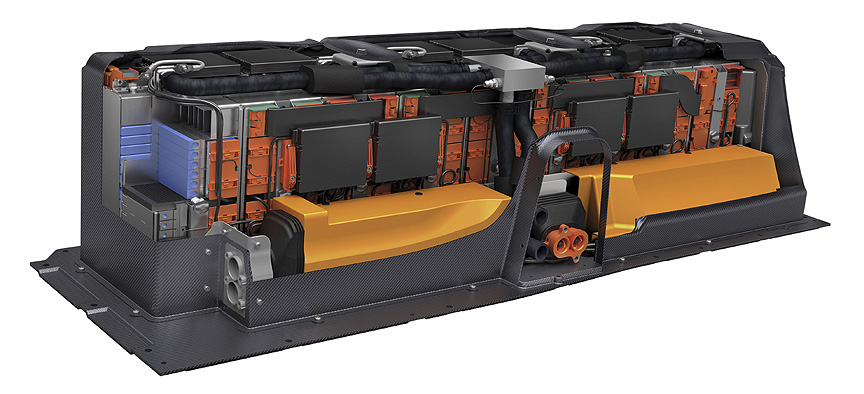
The power steering and air conditioning system are both run on electric motors. There is no need for the strong 12V battery for the on-board electrics, so the car has just a 20 Ah lightweight lithium-ion unit in addition to the hybrid system’s large battery. The 918 Spyder can brake using both electric motors and thus recuperate the energy. The electric energy is stored by a liquid-cooled lithium-ion battery comprising 312 individual cells with an energy content of 6.8 kWh. The 140 kg/308 lb battery provides best performance at temperatures 20-40°C/68-104°F. The battery had 7-year warranty.
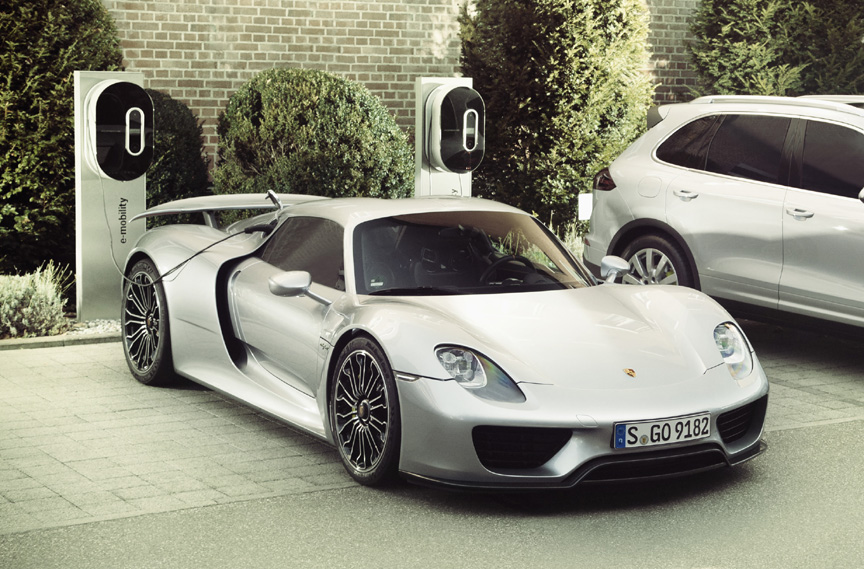
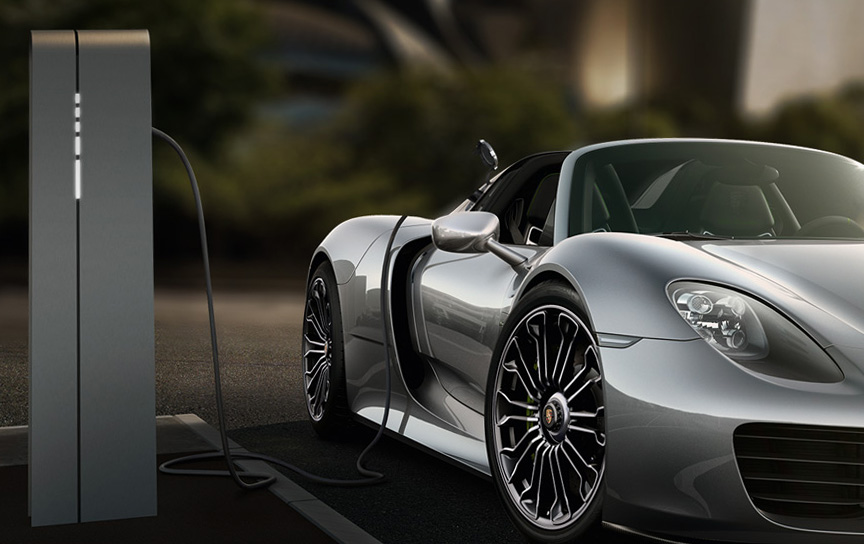
The plug-in interface enables the battery to be connected directly with the home mains supply. The battery can be charged within 4 hours from a 10 A power socket on the 230 V mains supply. A compact charging station for the garage was also supplied with the car which permits charging within approximately 2 hours.
A button on the steering wheel allows the driver to choose among five different running modes.
E-Power mode
It is for running the car under electric power alone, with a range of about 16 miles/25 km. When the vehicle is started up, this mode is the default operating mode as long as the battery is sufficiently charged. Acceleration to 62 mph/100 kmh takes 7 seconds in electric mode and top speed is 93 mph/150 km/h. When the charge state of the battery falls below a set minimum value, the vehicle automatically switches to hybrid mode.
Hybrid mode
Uses both the electric motors and the V8. At the speeds over 146 mph/235 km/h the front drive is decoupled.
Sport Hybrid mode
The V8 is now in constant operation and provides the main propulsive force. Most of the drive power goes to the rear wheels, with Torque Vectoring serving to additionally improve the car’s driving dynamics.
Race Hybrid mode
Meant for race track use, the drive systems are focused on pure performance. The combustion engine charges the battery when the driver is not utilising the maximum output. With the battery sufficiently charged, the push-to-pass button can be used to exploit the full power of the car, for example when overtaking or for just the maximum acceleration. In contrast to Sport Hybrid mode the electric motors run at their maximum power output limits.
Race Hybrid Hot Lap mode
The “Hot Lap” button in the middle of the map switch releases the last reserves and can only be activated in “Race Hybrid” mode. Similar to a qualification mode, this pushes the battery to its maximum power output limits for a few fast laps. This mode uses all of the available energy in the battery.
Performance
As you’d expect for a top-of-the-range Porsche, the 918 Spyder’s performance is simply blistering. This car is far from all show and no go. Power comes from a mid-mounted, racecar-derived 4.6-litre, 608hp V8 teamed with two electric motors, with the rear producing the equivalent of 154hp and the front – driving just the front wheels up to 146mph – producing 127hp. The combined output of the system is somewhere in the region of 887hp. A seven-speed PDK gearbox drives power to the rear wheels, meaning high-speed drifting is very possible. 0-62 comes up in around 2.8 seconds, with a top speed somewhere north of 211mph. Being a plug-in hybrid, the 918 Spyder can do all this and run silently in electric-only mode for a quoted range of 18 miles.
Ride & Handling
Ride in any high performance car is a relative thing, and compared with its peers the 918 Spyder returns a comfortable driving experience. Four-wheel drive, torque vectoring and rear-wheel steering help out in the twisty stuff too, while a multilink rear axle with adaptive electro-mechanical settings allows the car to be set up to the driver’s tastes. Porsche Active Suspension Management (PASM) allows each corner to talk to the rest of the car, optimising damping for the driving and road conditions. Even with its electro-mechanical steering setup, reviews of the 918 Spyder suggest it handles as good as the best from Porsche’s past. It’s as precise as you’d expect a Porsche hypercar to be. Compared with the lunatic V10 Carrera GT, you could even describe it as civilised.
Prices & Specs
Starting prices for the Porsche 918 were, comparatively for a hypercar from a major manufacturer, cheap. Entry to the brand-new 918 club started at €781,155, rising to €853,155 for Weissach package cars – for those seeking even greater performance that could do without some of the creature comforts, including comfy seats, sound deadening and about €72,000. Weissach cars also get extra-lightweight magnesium wheels, reducing the unsprung weight of the car.
Key Porsche 918 Suppliers
Building the 918 Spyder needed the cooperation with over 250 suppliers. Here are the most important ones:
- Alfing Kessler GmbH (Aalen-Wasseralfingen, Germany): lightweight crankshaft with central oil feed
- c2i s.r.o. (Dunajska Streda, Slovakia): rear mounting bracket featuring RTM technology, luggage compartment tray in prepreg format and CFRP radiator frame for the front and rear
- Connova AG (Villmergen, Schweiz): heat protection
- Eissmann Cotesa GmbH (Mittweida, Germany): CFK components such as central control unit and glove compartment fitting, dashboard carrier and door panel car-rier made from visible carbon fibre
- GKN Driveline GmbH (Offenbach, Germany, and Brunneck, Italy): front axle module (clutch and drive shaft)
- Magna Steyr Battery Systems GmbH & Co OG (Graz, Austria): 12 V lightweight main power supply battery featuring LiFePO4 technology
- MHG Fahrzeugtechnik GmbH/Proseria (Heubach, Germany): exhaust system made of Inconel®, coolant expansion tank
- Mubea Carbo Tech GmbH (Salzburg, Austria): carbon fibre reinforced plastic (CFRP) monocoque made using resin transfer moulding (RTM) technology
- S1nn GmbH & Co. KG (Stuttgart, Germany): HTML5-compatible infotainment system with tuner, media player, telephone, navigation system and vehicle functions (ADR Automatic Distance Regulation – display and domain controller)
- Simfy AG (Berlin, Germany): APP based flat rate for music
Porsche 918 Spyder Press Release
Introducing the Porsche 918 Spyder
A unique combination of performance and efficiency
May 16, 2013 | Atlanta. The 918 Spyder embodies the essence of the Porsche idea: it combines pedigree motor racing technology with excellent everyday utility, and maximum performance with minimum consumption. The task faced by the development team was to create the super sports car for the next decade with a highly efficient and powerful hybrid drive. Developing the car from scratch, appropriately beginning with a sheet of white paper, allowed the team to come up with a no-compromise concept. The entire car was designed around the hybrid drive. The 918 Spyder therefore demonstrates the potential of the hybrid drive to a degree never seen before: the parallel improvement of both efficiency and performance without one being at the cost of the other. This is the idea that has made the Porsche 911 the most successful sports car in the world for 50 years. In short, the 918 Spyder will act as the gene pool for the Porsche sports cars of the future.
The 918 Spyder reveals its close links to motorsport in a variety of ways. It has been designed, developed and produced by Porsche engineers who build race cars, in cooperation with series production specialists. A great deal of insight gained from the development of Porsche race cars for the 24 hours race in Le Mans in 2014 is thus integrated into the 918 Spyder – and vice versa. The structural concept of the 918 Spyder with a rolling chassis as its basis – a basic vehicle that can be driven even without a body – is race car tradition at Porsche. The concept of the V8 engine originates from the LMP2 RS Spyder race car. The load-bearing structures, the monocoque and subframe, are made of carbon fiber reinforced polymer. Porsche has many years of experience with this high-strength, lightweight construction material and has again achieved top results with the development of the series production 918 Spyder. Many parts of the super sports car come from manufacturers who have a proven record as suppliers for motorsport vehicles.
Hybrid drive brings advantages in terms of driving dynamics
A key message of the 918 Spyder is that the hybrid drive from Porsche is a plus for no-compromise driving dynamics. Drivers can experience this thanks to the unique all-wheel drive concept with a combination of combustion engine and electric motor on the rear axle and the second electric motor on the front axle. It is based on knowledge gained by Porsche during motor races with the successful 911 GT3 R Hybrid. Due to the additional, individually controllable front drive, new driving strategies for extremely high, safe cornering speeds can be implemented, especially for bends. Furthermore, the advanced “boost” strategy manages the energy of the electric drive so intelligently that, for every sprint with maximum acceleration, the full power of the 918 Spyder can be tapped into by simply pressing the accelerator down fully. In short, the 918 Spyder allows even drivers without motorsport training to experience the potential of advanced longitudinal and transverse dynamics.
The Porsche 918 Spyder also has the potential to break many records. The current lap time for the North Loop of the Nürburgring is 7:14 minutes. This time was achieved in the presence of international journalists during test drives in September 2012 – more than a year before start of production. The 918 Spyder prototype was therefore approximately 20 seconds quicker than the Porsche Carrera GT. More test drives on the Nürburgring North Loop will follow. An even more important factor is that the 918 Spyder surpasses previous models and competitors by far in its efficiency as well. As a plug-in hybrid vehicle, it systematically combines the dynamic performance of a racing machine with low fuel consumption. To sum it up: maximum driving fun with minimal fuel consumption.
Carbon monocoque guarantees lightweight design with a low center of gravity
The 918 Spyder utilizes the best state-of-the-art technologies, taken straight from motor racing, to achieve its top performance. The entire load-bearing structure is made of carbon fiber reinforced polymer (CFRP) for extreme torsional rigidity. Additional crash elements at the front and rear absorb and reduce the energy of a collision. The car’s unladen weight of approximately 3,715 lbs. (3,616 lbs. with “Weissach” package), an excellent low weight for a hybrid vehicle of this performance class, is largely attributable to this concept.
The drivetrain components and all components weighing over 110 lbs. are located as low and as centrally as possible within the vehicle. This results in a slightly rear end biased axle load distribution of 57 percent on the rear axle and 43 percent on the front axle, combined with an extremely low center of gravity at approximately the height of the wheel hubs, which is ideal for driving dynamics. The central and low position of the traction battery directly behind the driver not only supports efforts to concentrate masses and lower the center of gravity; it also provides the best temperature conditions for optimum battery power capacity.
Chassis with race car genes and rear-axle steering
The multi-link chassis of the Porsche 918 Spyder is inspired by motorsport design, complemented by additional systems such as the PASM adaptive shock-absorber system and rear-axle steering. Basically, this incorporates an electro-mechanical adjustment system at each rear wheel. The adjustment is speed-sensitive and executes steering angles of up to three degrees in each direction. The rear axle can therefore be steered in the same direction as the front wheels or in opposition to them. At low speeds, the system steers the rear wheels in a direction opposite to that of the front wheels. This makes cornering even more direct, faster and more precise, and it reduces the turning circle. At higher speeds, the system steers the rear wheels in the same direction as the front wheels. This significantly improves the stability of the rear end when changing lanes quickly. The result is very secure and stable handling.
Porsche Active Aerodynamic (PAA) for different driving modes
Porsche Active Aerodynamic (PAA), a system of adjustable aerodynamic elements, ensures unique and variable aerodynamics; its layout is automatically varied over three modes ranging from optimal efficiency to maximum downforce and is tuned to the operating modes of the hybrid drive system. In “Race” mode, the retractable rear wing is set to a steep angle to generate high downforce at the rear axle. The spoiler positioned between the two wing supports near the trailing edge of the airflow also extends. In addition, two adjustable air flaps are opened in the underfloor in front of the front axle, and they direct a portion of the air into the diffuser channels of the underbody structure. This also produces a “ground effect” at the front axle.
In “Sport” mode, the aerodynamic control system reduces the attack angle of the rear wing somewhat, which enables a higher top speed. The spoiler remains extended. The aerodynamic flaps in the underfloor area close, which also reduces aerodynamic drag and increases attainable vehicle speeds. In “E” mode, the control is configured entirely for low aerodynamic drag; the rear wing and spoiler are retracted and the underfloor flaps are closed.
Adjustable air inlets under the main headlights round off the adaptive aerodynamic system. When the vehicle is stationary and in “Race” and “Sport” mode, they are opened for maximum cooling air intake. In “E-Power” and “Hybrid” modes, they close immediately after the car is driven off in order to keep aerodynamic drag to a minimum. They are not opened until the car reaches speeds of approximately 81 mph or when cooling requirements are higher.
From comfortable to race-ready: five modes for three motors
The core of the 918 Spyder concept is its distribution of propulsive power among the three power units; their cooperation is controlled by an intelligent management system. To best exploit these different approaches, the Porsche developers defined five operating modes that can be activated via a “map switch” on the steering wheel, just like in motorsport cars. On the basis of this pre-selection, the 918 Spyder applies the most suitable operating and boost strategy without driver intervention, thus allowing the driver to concentrate fully on the road.
Quiet and elegant: “E-Power”
When the vehicle is started up, the “E-Power” mode is the default operating mode as long as the battery is sufficiently charged. In ideal conditions, the 918 Spyder can cover approximately 18 miles on purely electric power. Even in pure electric mode, the 918 Spyder accelerates from 0 to 62 mph in seven seconds and can reach speeds of up to 93 mph. In this mode, the combustion engine is only used when needed. If the battery’s charge state drops below a set minimum value, the vehicle automatically switches to hybrid mode.
Efficient and comfortable: “Hybrid”
In “Hybrid” mode, the electric motors and combustion engine work alternately with a focus on maximum efficiency and minimum fuel consumption. The use of individual drive components is modified as a function of the current driving situation and the desired performance. The Hybrid mode is typically used for a fuel economy-oriented driving style.
Sporty and dynamic: “Sport Hybrid”
In more dynamic situations, the 918 Spyder selects the “Sport Hybrid” mode for its power sources. The combustion engine now operates continuously and provides the main propulsive force. In addition, the electric motors provide support in the form of electric boosting or when the operating point of the combustion engine can be optimized for greater efficiency. The focus of this mode is on performance and a sporty driving style at top speed.
For fast laps: “Race Hybrid”
“Race Hybrid” is the mode for maximum performance and an especially sporty driving style. The combustion engine is chiefly used under high load, and charges the battery when the driver is not utilizing its maximum output. Again, the electric motors provide additional support in the form of boosting. Furthermore, the gear-shifting program of the PDK is set up for even sportier driving. The electric motors are used up to the maximum power output limit to deliver the best possible performance for the race track. In this mode, the battery charge state is not kept constant, rather it fluctuates over the entire charge range. In contrast to Sport Hybrid mode, the electric motors run at their maximum power output limit for a short time for better boosting. This increased output is balanced by the combustion engine charging the battery more intensively. Electric power is thus available even with several very fast laps.
For pole position: “Hot Lap”
The “Hot Lap” button in the middle of the map switch releases the final reserves of the 918 Spyder and can only be activated in “Race Hybrid” mode. Similar to a qualification mode, this pushes the traction battery to its maximum power output limits for a few fast laps. This mode uses all of the available energy in the battery.
Main propulsion: the race car’s eight cylinder engine
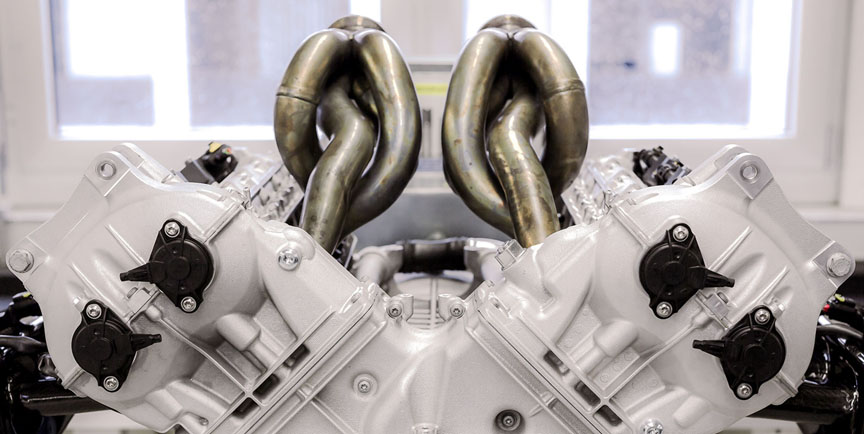
The main source of propulsion is the 4.6-liter, eight cylinder engine that produces 608 hp of power. The engine is derived directly from the power unit of the successful RS Spyder, which explains why it can deliver engine speeds of up to 9,150 rpm. Like the race engine of the RS Spyder, the 918 Spyder power unit features dry-sump lubrication with a separate oil tank and oil extraction. To save weight, components such as the oil tank, the air filter box integrated into the subframe and the air induction are made of carbon fiber reinforced polymer. Further extensive lightweight design measures have resulted in such features as titanium connecting rods, thin-wall, low-pressure casting on the crank case and the cylinder heads, a high-strength, lightweight steel crankshaft with 180 degrees crankpin offset and the extremely thin-walled alloy steel/nickel exhaust system. Striking features of the V8 are that it no longer supports any auxiliary systems, there are no external belt drives and the engine is therefore particularly compact. Weight and performance optimizations achieve a power output per liter of approx. 133 hp/l – the highest power output per liter of a Porsche naturally aspirated engine – which is significantly higher than that of the Carrera GT (106 hp/l) and outstanding for a naturally aspirated engine.
Unique race car design heritage: top pipes
It isn’t just this engine’s performance but also the sound it makes that stokes the emotionality of the 918 Spyder. This is attributable first and foremost to the so-called top pipes: the tailpipes terminate in the upper part of the rear end immediately above the engine. No other production vehicle uses this solution. The top pipes’ greatest benefit is optimal heat removal, because the hot exhaust gases are released via the shortest possible route, and exhaust gas back pressure remains low. This design requires a new thermodynamic air channeling concept. With the HSI engine, the hot side is located inside the cylinder V, the intake channels are on the outside. There is another benefit as well: the engine compartment remains cooler. This is especially beneficial to the lithium-ion traction battery, as it provides optimum performance at temperatures between 68 and 104 degrees Fahrenheit. Consequently, less energy needs to be used for active cooling of the battery.
In parallel in the drivetrain: hybrid module
The V8 engine is coupled to the hybrid module, since the 918 Spyder is designed as a parallel hybrid like the current hybrid models from Porsche. Essentially, the hybrid module comprises a 115 kW electric motor and a decoupler that serves as the connection with the combustion engine. Because of its parallel hybrid configuration, the 918 Spyder can be powered at the rear axle either individually by the combustion engine or electric motor or via both drives jointly. As is typical for a Porsche super sports car, the power pack in the 918 Spyder has been placed in front of the rear axle, and does not have any direct mechanical connection to the front axle.
Upside-down for a low center of gravity: Doppelkupplung
A seven-speed Doppelkupplung (PDK) transmission handles power transmission to the rear axle. The high-performance transmission is the sportiest version of the successful PDK; it has undergone a complete redesign for the 918 Spyder and has been further optimized for high performance. To ensure a low mounting position for a low center of gravity of the entire vehicle, the gear unit was turned “upside down” by rotating it 180 degrees about its longitudinal axis, in contrast to other Porsche series. If no power is required on the rear axle, the two motors can be decoupled by opening the decoupler and PDK clutches. This is the action behind the Porsche hybrid drive’s typical “coasting” with the combustion engine switched off.
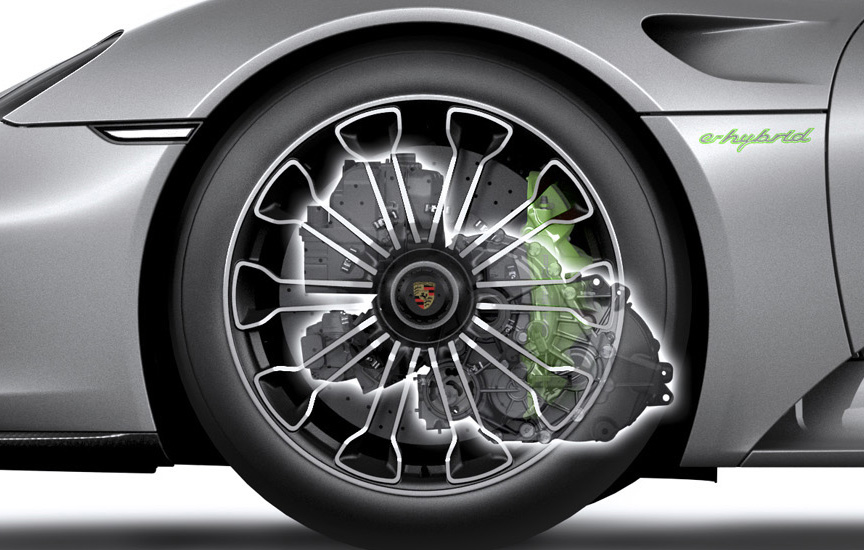
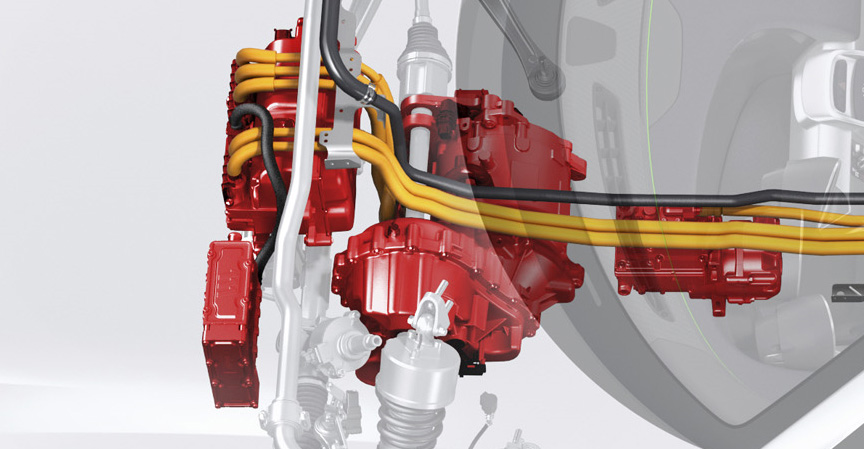
Independent all-wheel drive: front axle with electric motor
On the front axle, there is another independent electric motor with an output of approximately 95 kW. The front electric drive unit drives the wheels at a fixed ratio. A decoupler decouples the electric motor at high speeds to prevent the motor from over-revving. Drive torque is independently controlled for each axle. This makes for very responsive all-wheel drive functionality that offers great potential in terms of traction and driving dynamics.
Lithium-ion battery with plug-in charging system
The electric energy for the electric motors is stored by a liquid-cooled lithium-ion battery comprising 312 individual cells with an energy content of about seven kilowatt hours. The battery of the 918 Spyder has a performance-oriented design in terms of both power charging and output, so that it can fulfill the performance requirements of the electric motor. The power capacity and the operating life of the lithium-ion traction battery depend on several factors, including thermal conditions. That is why the battery of the 918 Spyder is liquid-cooled by a dedicated cooling circuit. The global warranty period for the traction battery is seven years.
To supply it with energy, Porsche developed a new system with a plug-in vehicle charge port and improved recuperation potential. This vehicle charge port in the B-pillar on the front passenger side lets users connect the storage battery to an electrical supply at home to charge it. The charge port is standardized for the country of purchase. The on-board charger is located close to the traction battery. It converts the alternating current of the household electric supply into direct current with a maximum charge output of 3.6 kW. Using the supplied Porsche Universal Charger (AC), the traction battery can be charged with a conventional wall plug in seven hours from a ten ampere rated, fused power socket a US 110 Volt household electrical supply, for example. Furthermore, the Porsche Universal Charger (AC) can be installed at home in the garage using the Charging Dock. It enables rapid and convenient charging within approximately two hours, irrespective of regional conditions. The Porsche Speed Charging Station (DC) is available as an optional extra. It can fully charge the high-voltage battery of the 918 Spyder in just 25 minutes.
Pioneering control concept: clear organization of the cockpit
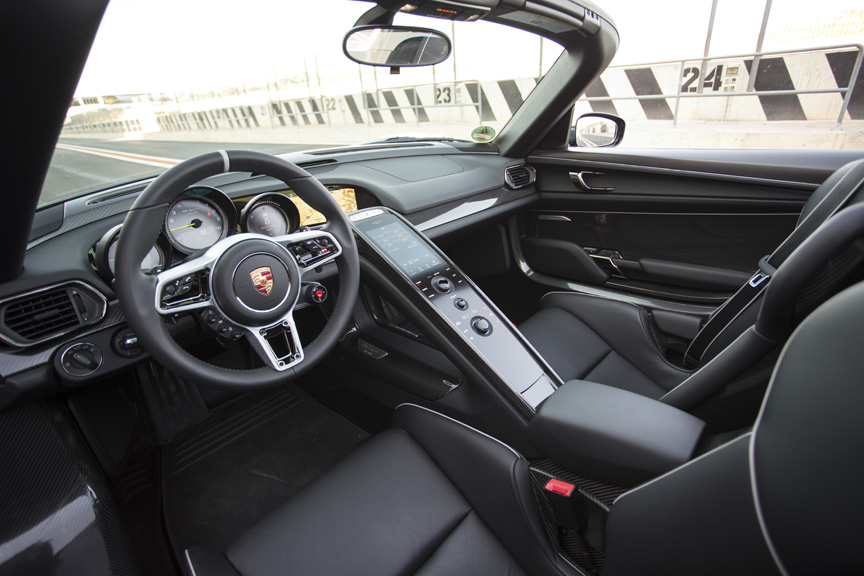
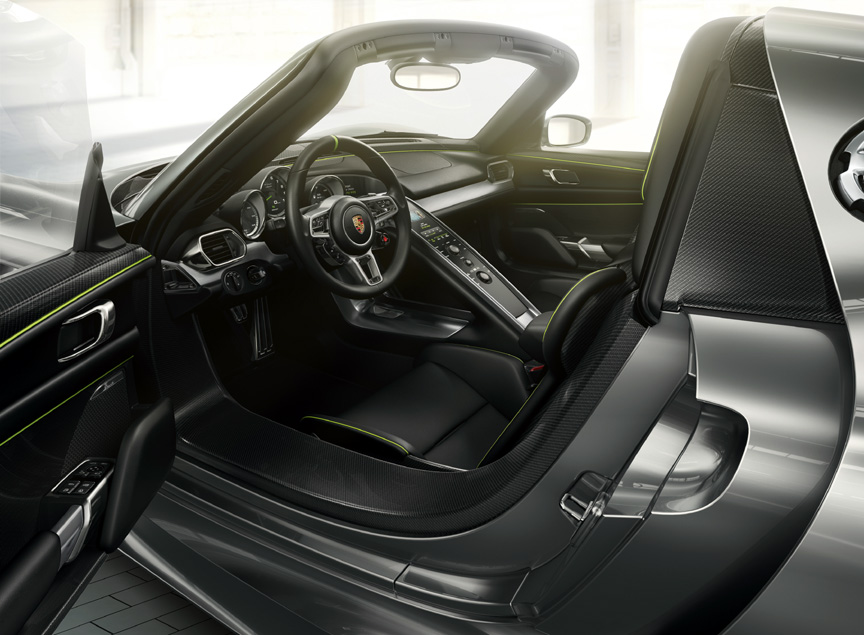
The driver is the focus of all technology in the future Porsche super sports car. A cockpit was created for the driver that is typical of the brand and pioneering in its clarity. It is partitioned into two basic areas. First, there are the controls that are important for driving, which are grouped around the multifunction steering wheel, combined with driver information displayed on three large round instruments. Second, there is the infotainment block that is housed in the lifted center console, which was introduced in the Carrera GT. Control functions, e.g. for the automatic climate control system, wing adjustment, lighting and Porsche Communication Management (PCM), including a Burmester high-end sound system, can be intuitively operated by multitouch with a new type of black panel technology.
For even higher performance: the Weissach package
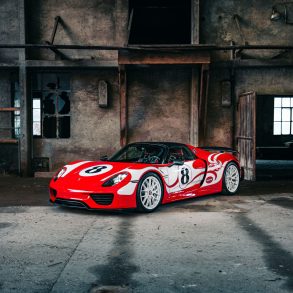
For very performance-oriented customers of the 918 Spyder, Porsche offers the “Weissach” package. These modified super sports cars can be recognized at first glance by special colors and designs that are based on legendary Porsche race cars. The roof, rear wings, rear-view mirrors and frames of the windscreen are made of visible carbon. Parts of the interior are upholstered with Alcantara instead of leather, and visible carbon replaces much of the aluminum. Sound insulation has been reduced. The emphasis on performance is not just visual: very lightweight magnesium wheels reduce unsprung masses; gross weight was reduced by about 77 lbs. The benefits are experienced in further improved dynamic performance. Other references from motorsport are six-point seatbelts for driver and front passenger, optional film-coating instead of body paint, as well as additional aerodynamic body parts in visible carbon.
Porsche redefined: a new super sports car for a new decade
The 918 Spyder continues a long tradition of super sports cars at Porsche; as technology platforms, as the driving force behind both car emotion and car evolution and as the ultimate sports cars of their decades: the Carrera GTS, the first Porsche Turbo, the 959, the 911 GT1, the Carrera GT. More than any of its predecessors, the 918 Spyder is providing key impetus for developing technologies for future vehicle concepts. It offers a complete package of components that reflect Porsche DNA – more concentrated than ever before.
Cool Porsche 918 Facts & Details
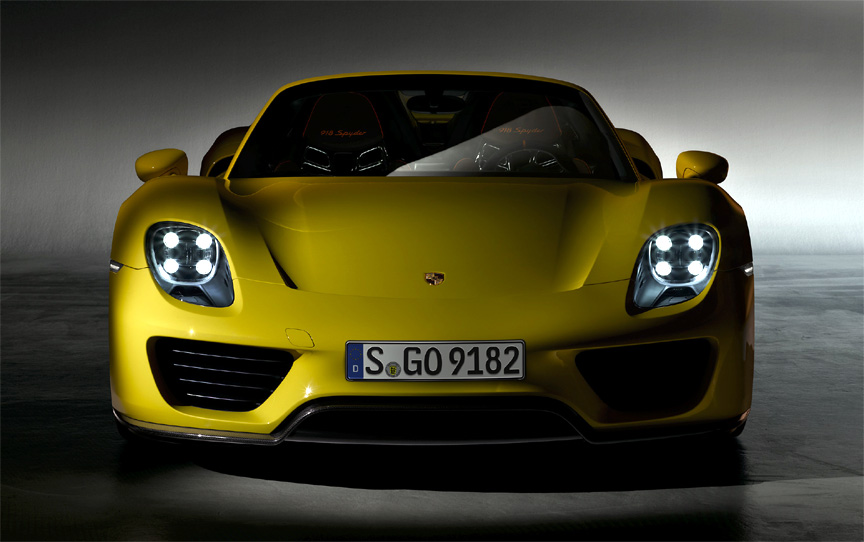 235 LEDs were totally used in the car and no single incandescent bulb © Porsche
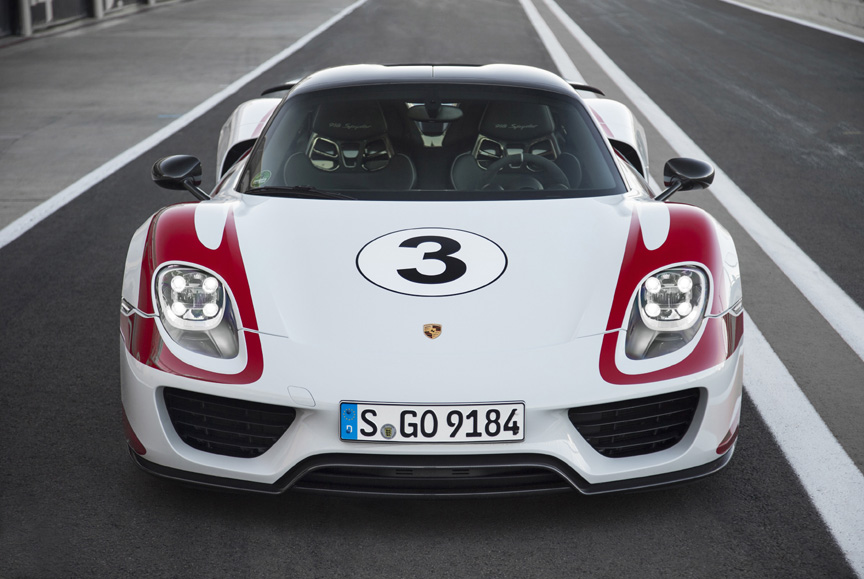 The windshield and rear window are of lightweight thin glass as well as are of thin glass the hydrophobically coated side windows © Porsche
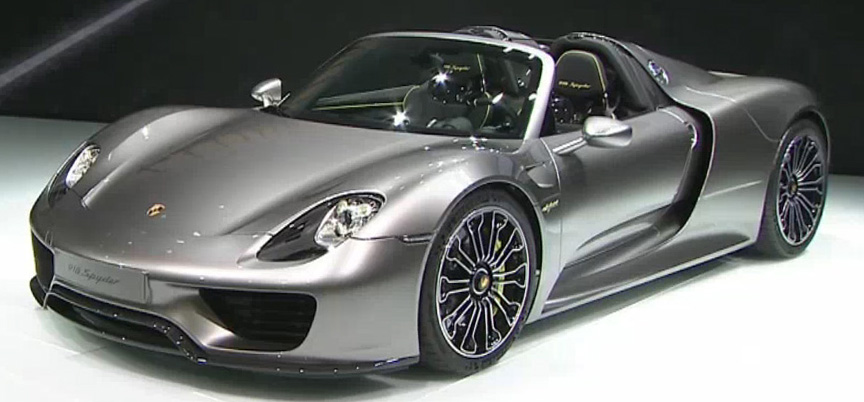 The Liquid Metal coating in Silver or Chrome Blue costs as much as a new Boxster. Please note, it is not a paint, but a layer of metal applied on the carbon fibre. © Porsche
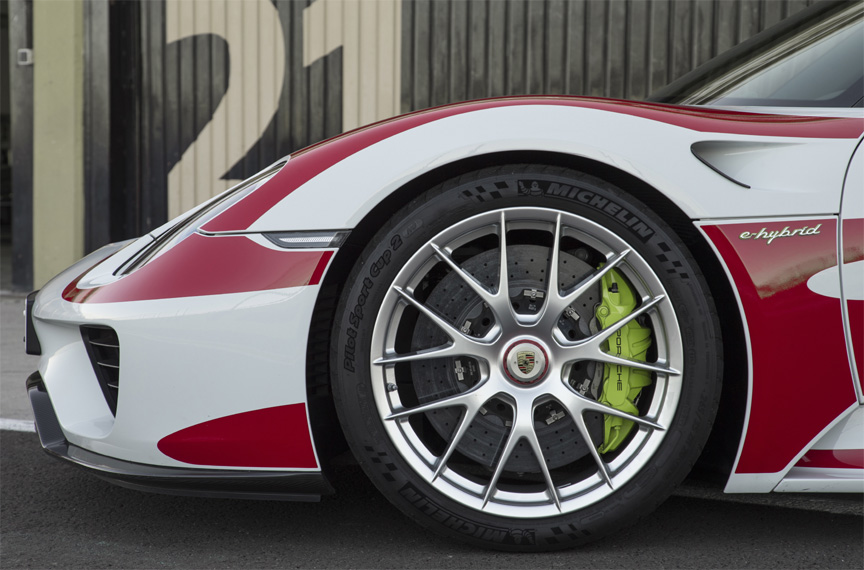 Magnesium wheels © Porsche
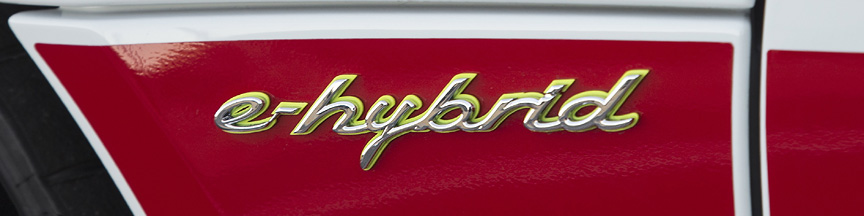 In Porsche’s vocabulary ‘e-‘ means ‘plug-in’ © Porsche
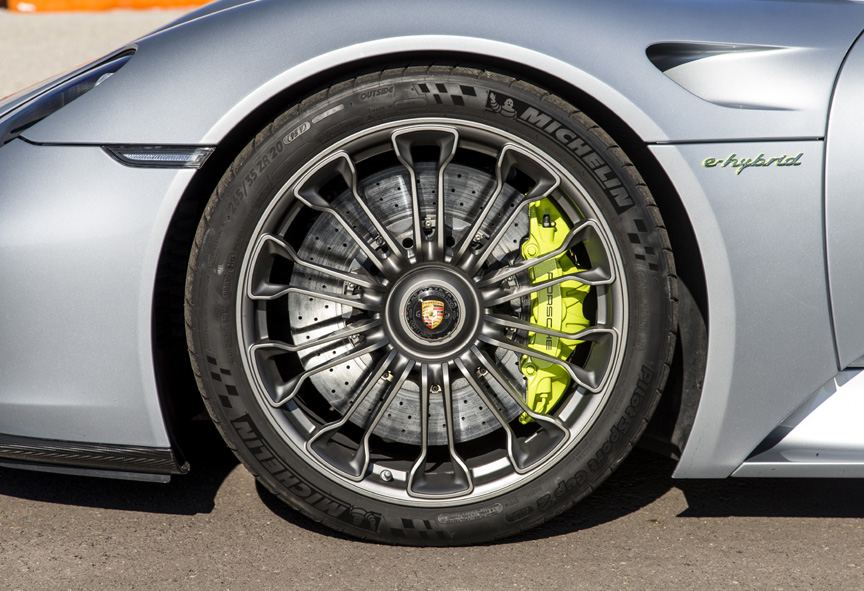 Standard forged wheels © Porsche
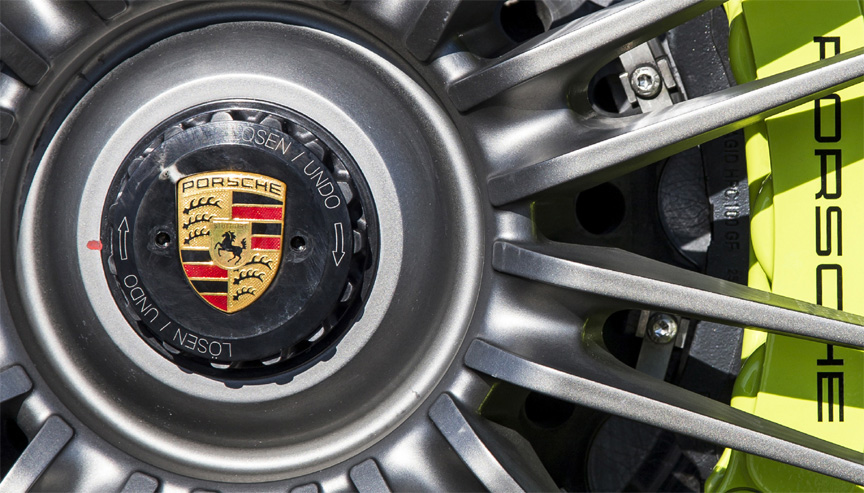 Marked with red paint to detect the possible failure of central locking nut © Porsche
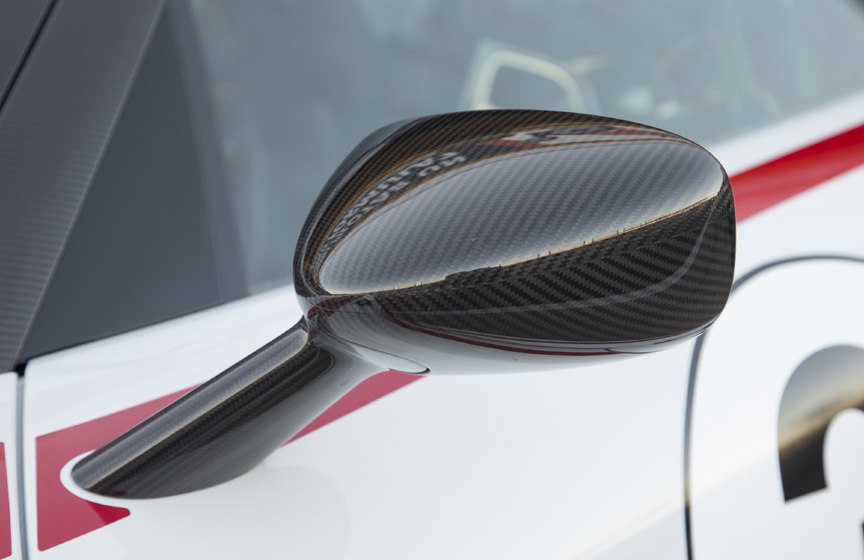 Exposed CFRP mirror housings of the Weissach Edition © Porsche
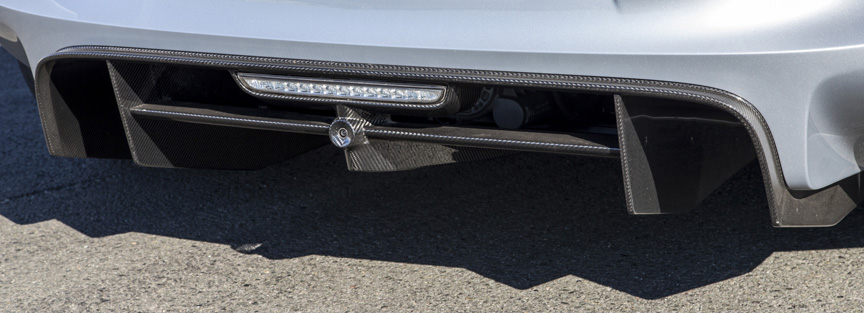
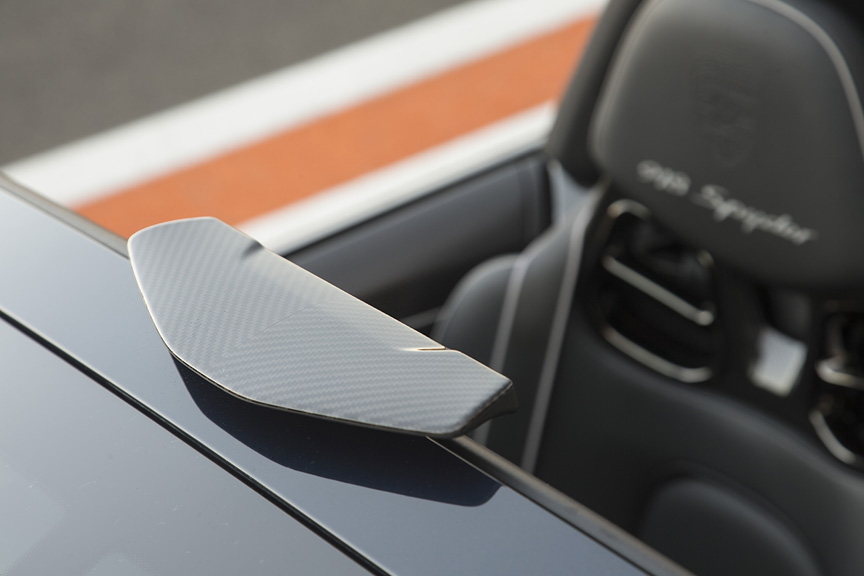 Aerodynamic part that reduces the wind vortex and this way keeps the exhaust gases away from the open cockpit © Porsche
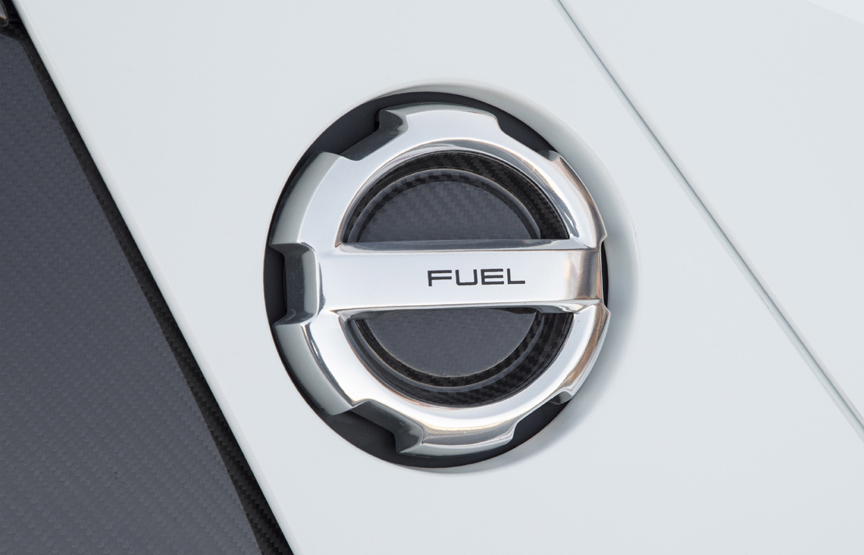 Fuel filler cap is on the left and charging socket on the right side of the car (was vice versa on the concept car) © Porsche
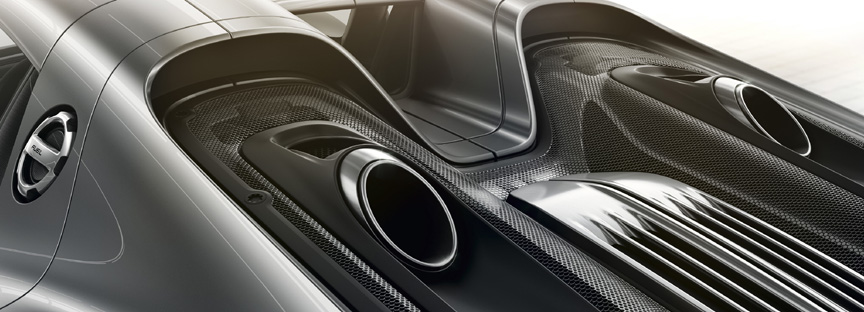 Make sure you tank the car by yourself and be cautious with the fuel fumes near the hot exhaust pipes. The 70 liter tank is made of aluminium. © Porsche
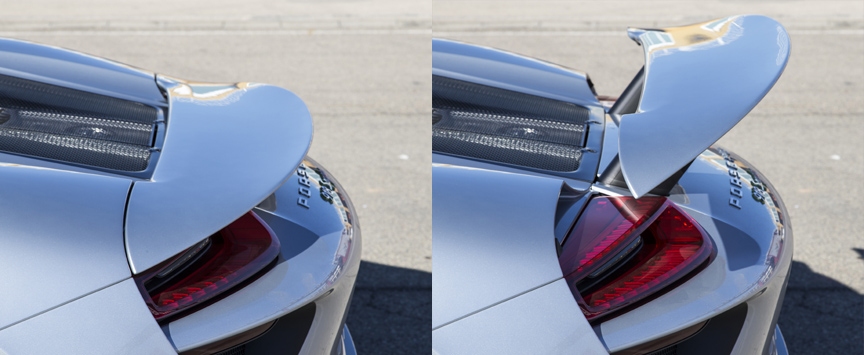 The wing moves up and in an angle © Porsche
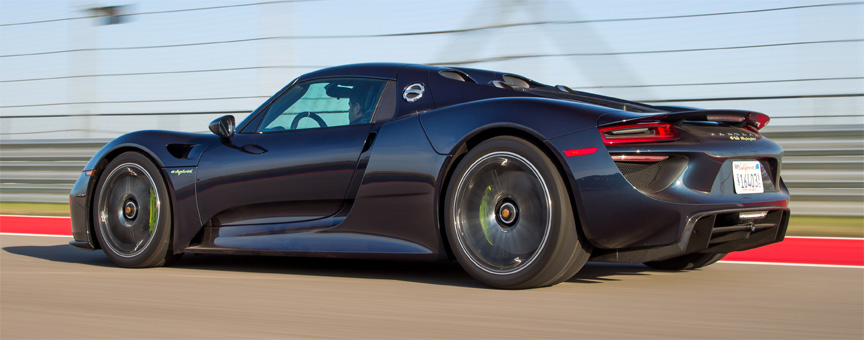 US-versions have red side lamps (32% of all the 918 made) © Porsche
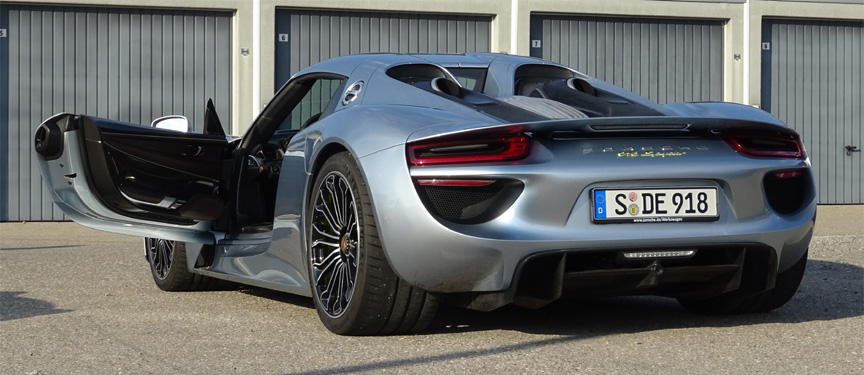
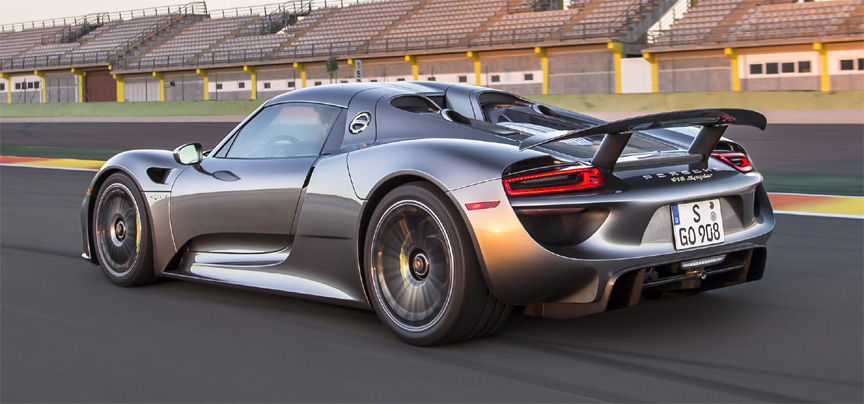 USA-version with German number plates in Spain (Circuit Ricardo Tormo, Valencia) © Porsche
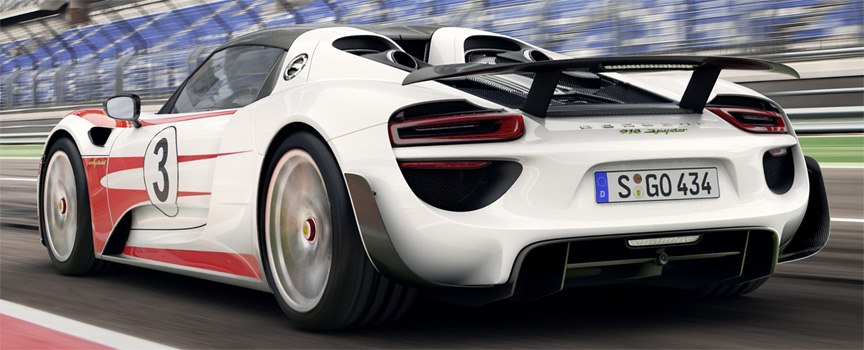 Weissach aerodynamic package and Salzburg livery © Porsche
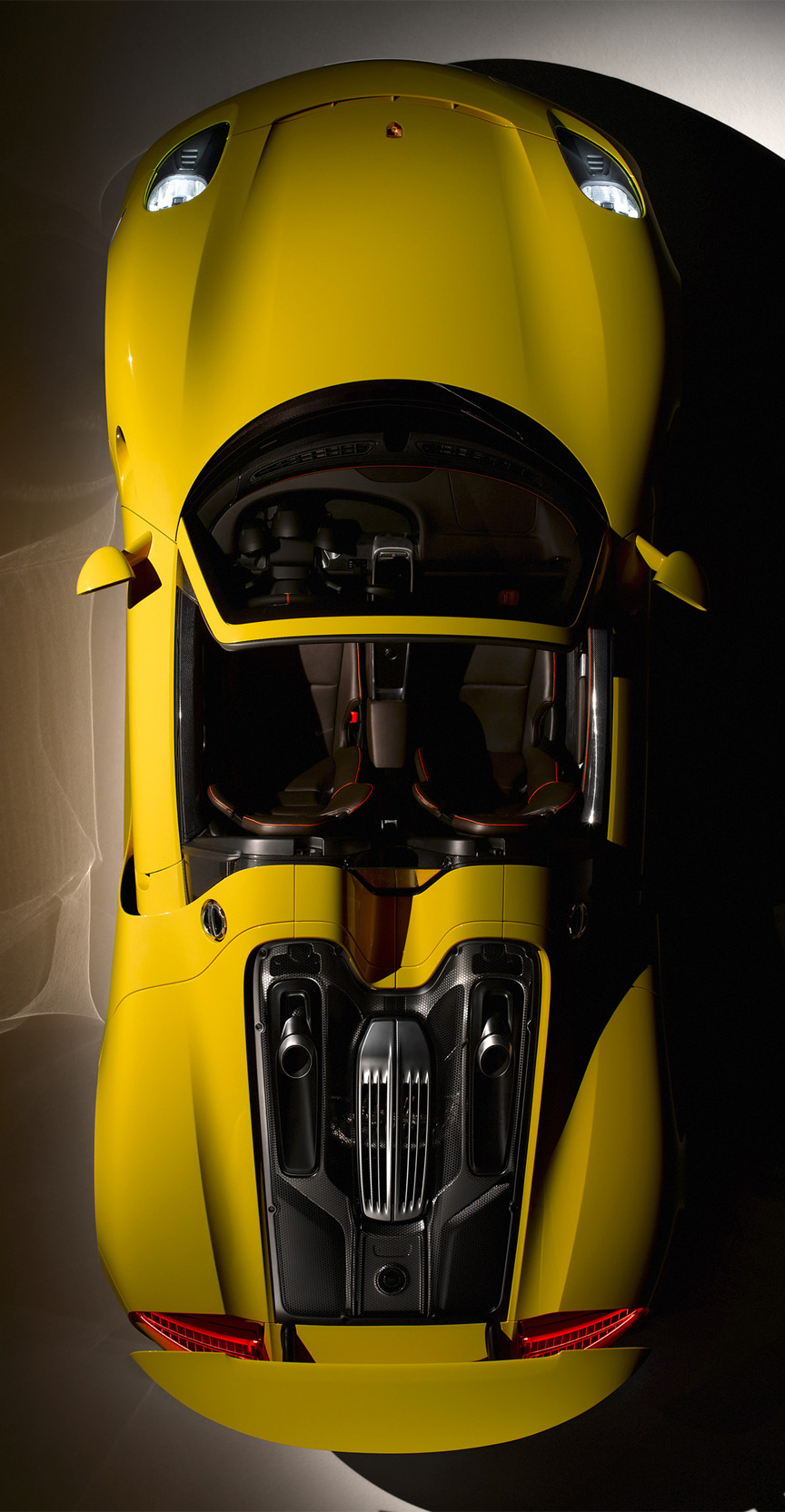 Single arm windscreen wiper system © Porsche
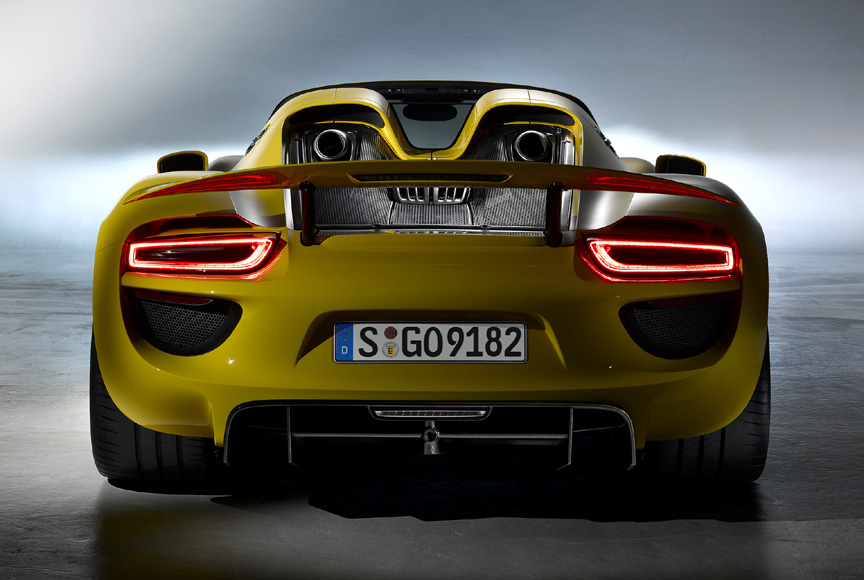 Perfect from any angle – the praise goes to the design teams of Michael Mauer and Anthony Hatter! © Porsche
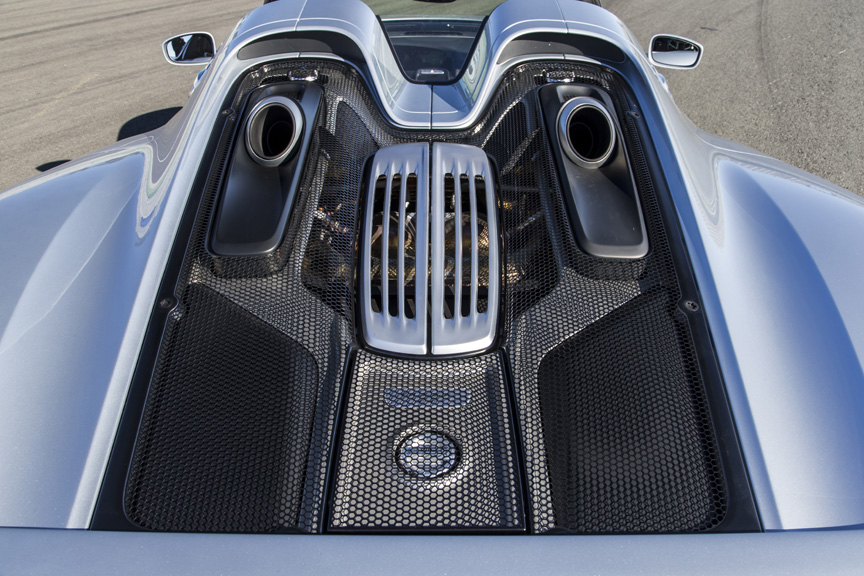 The 4.6V8 can rev up to 9150 rpm. © Porsche
 Porsche uses Acid Green contrasting color to distinguish the hybrid models from the others. © Porsche
 © Porsche
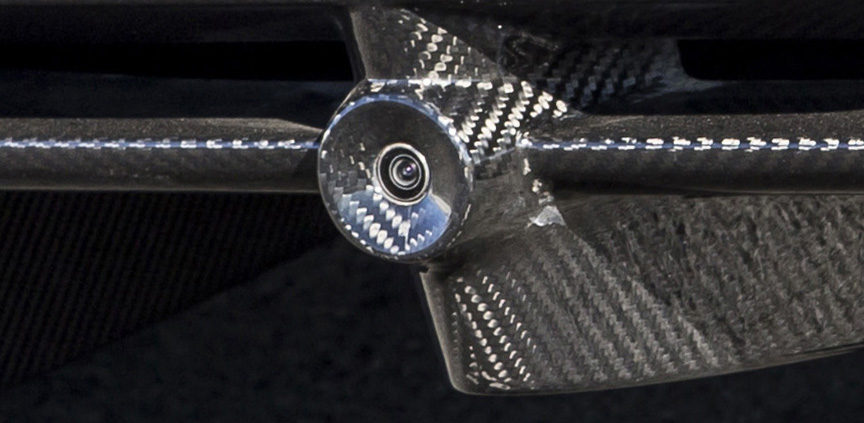 The rear view camera can be used also as a rear view mirror – it works also when driving forward © Porsche
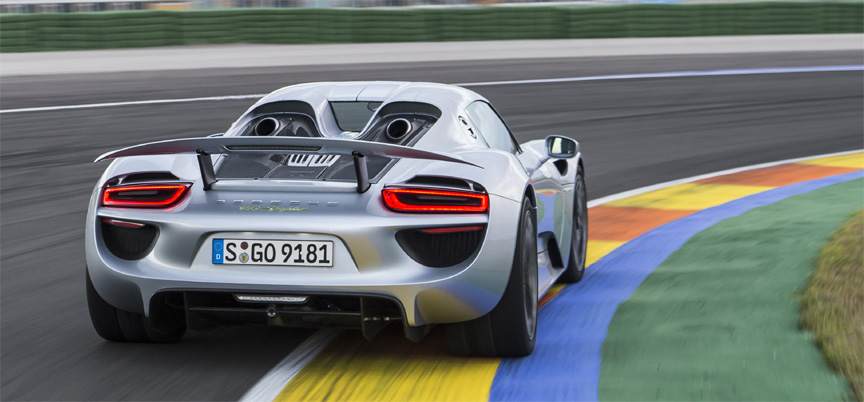 Raised rear wing. © Porsche
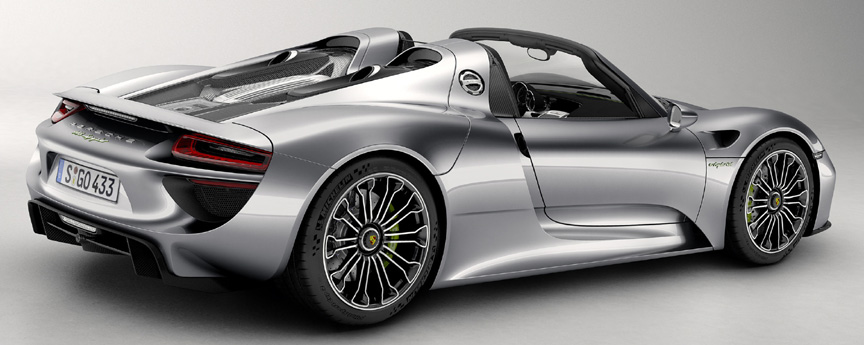 © Porsche
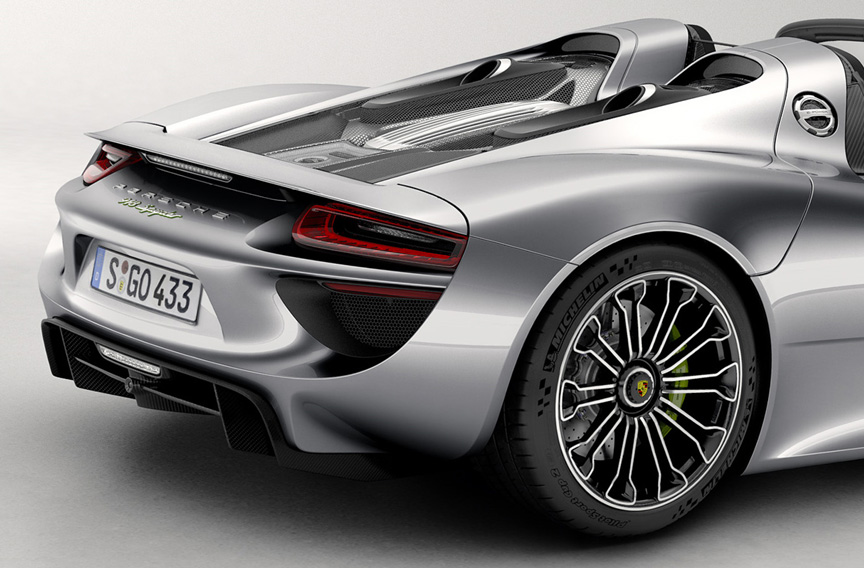 © Porsche
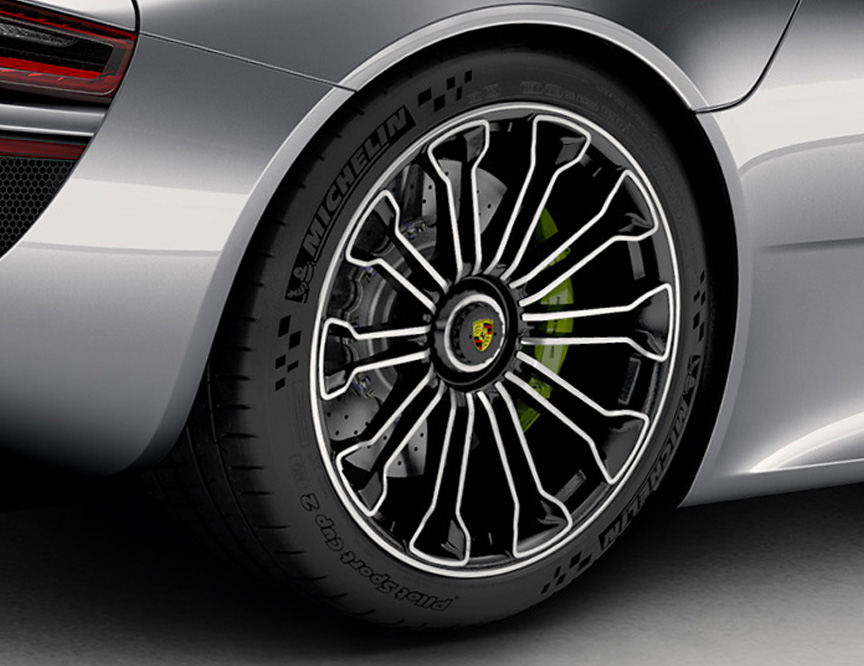 Michelin Pilot Sport Cup 2 – the best cannot be the best without the best. The tyre pressure monitoring system has Normal and Performance air pressure monitoring. © Porsche
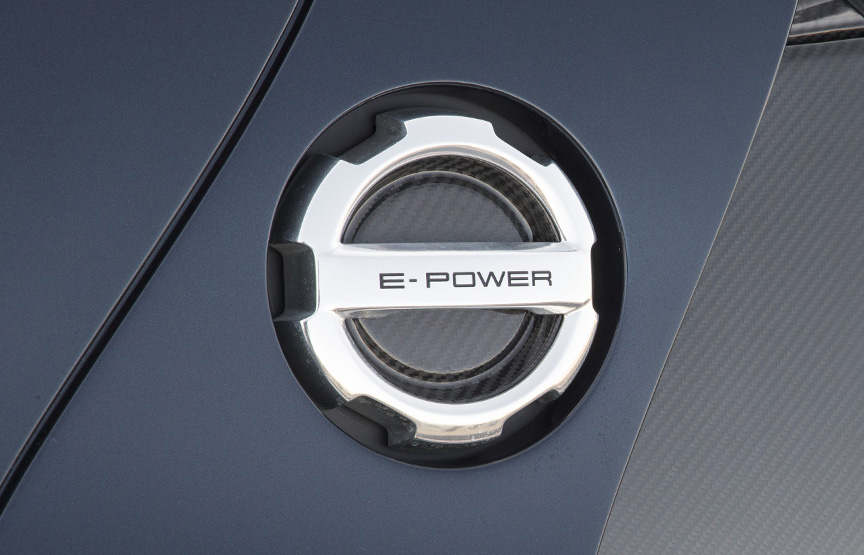 © Porsche
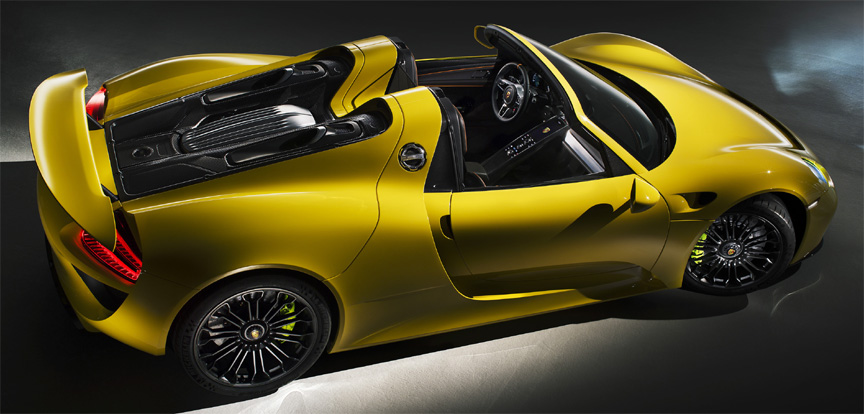 © Porsche
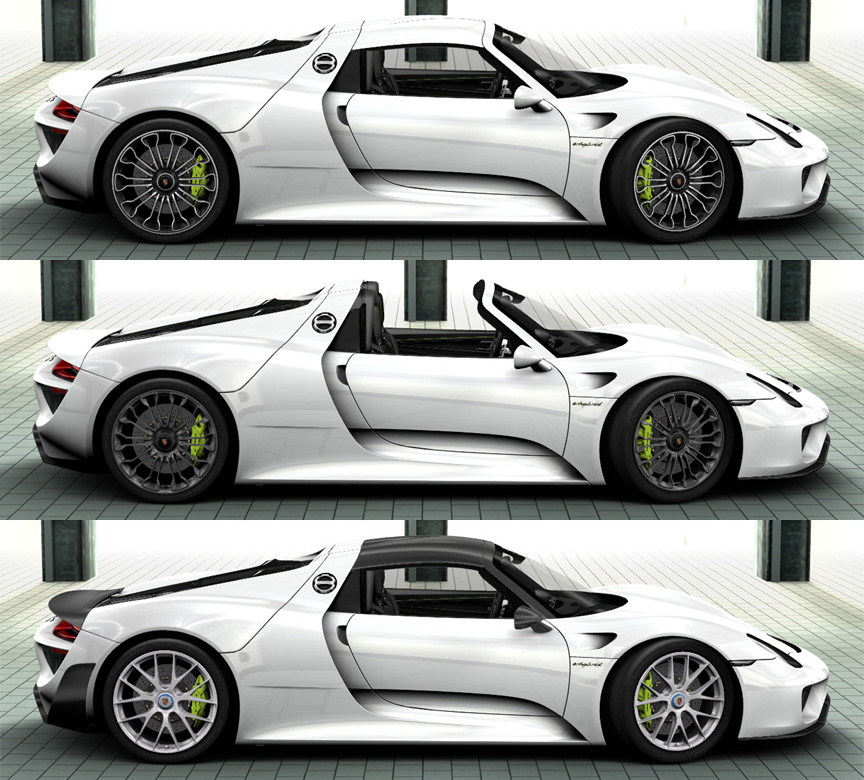 1: standard equipment, 2: wheels painted Platinum, roof panel removed, 3: Weissach package (includes magnesium wheels). © Porsche
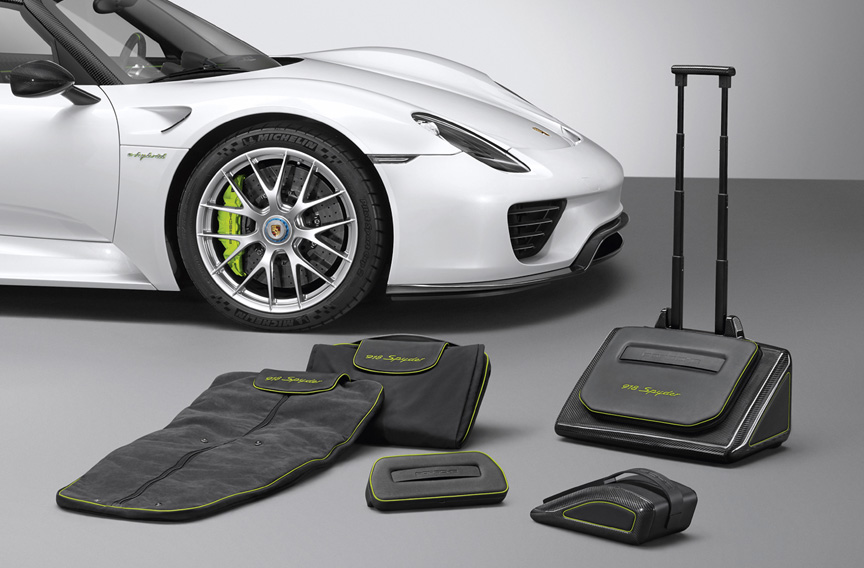 Designed by the Porsche Design Studio and developed by Porsche in Weissach, the luggage collection is an ideal match for the interior. The luggage set was available in the same color combinations as the interior: Garnet Red-Silver, Onyx Black-Acid Green, Onyx Black-Silver, Mocca Brown-Silver and Mocca Brown-Orange. © Porsche
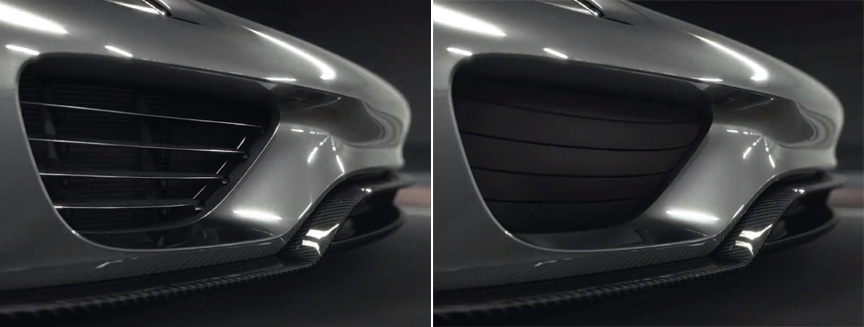 Active aerodynamics: the ribs are closed when the cooling is not needed in order to reduce aerodynamic drag. © Porsche
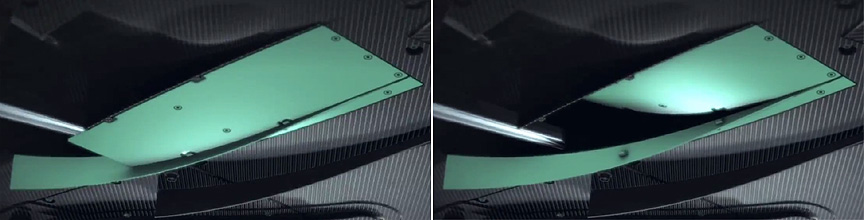 Active aerodynamics under the car © Porsche
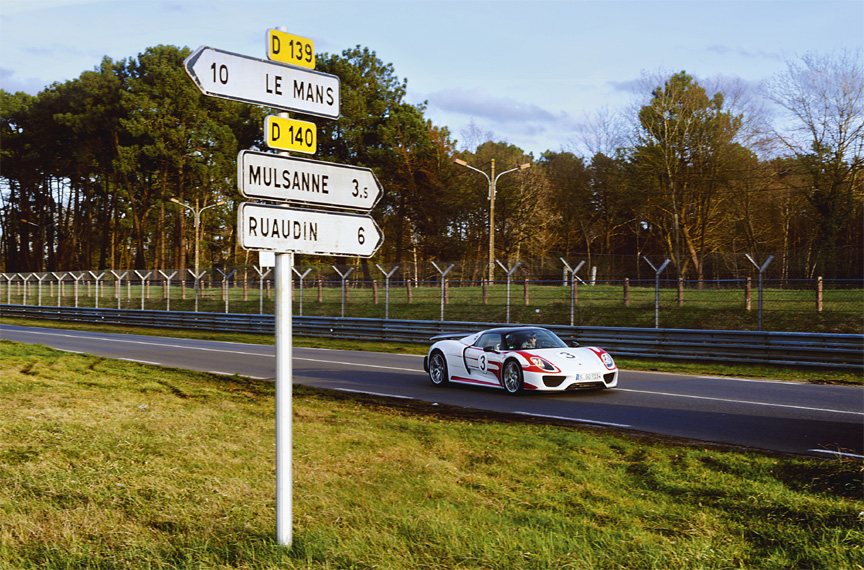 On the public road that once in a year transforms into the Le Mans 24 hour race track © Porsche
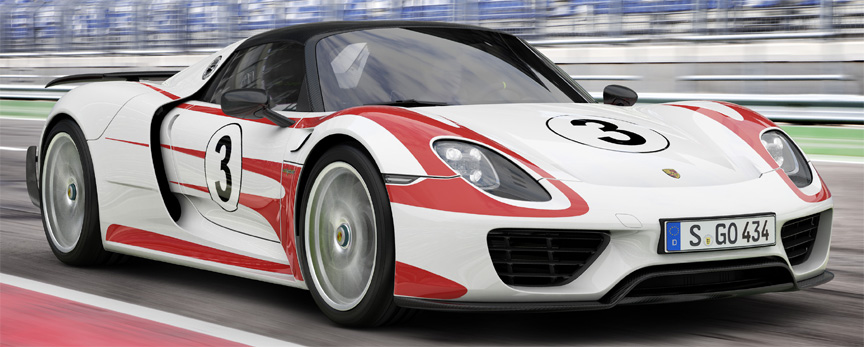 Salzburg livery decals and Weissach package. © Porsche
 © Porsche
 © Porsche
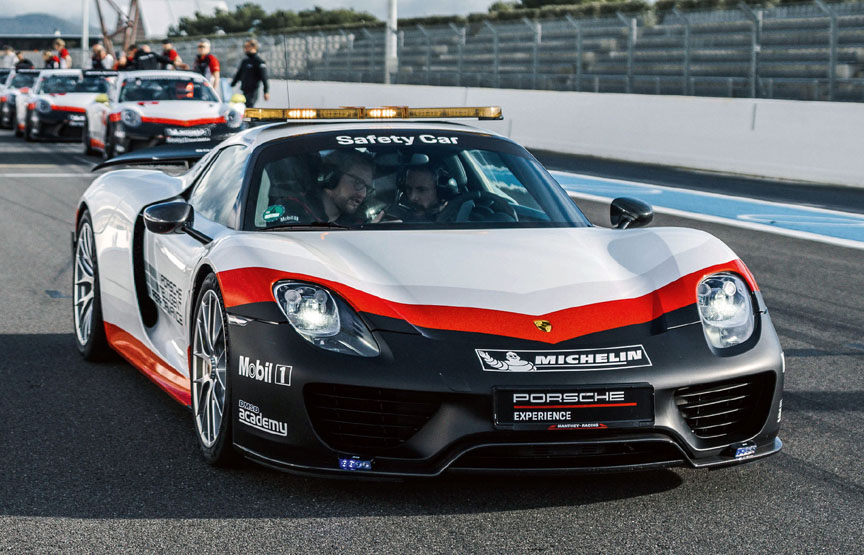 918 Spyder with Weissach pack as the safety car at the 2019 Porsche Racing Experience. © Porsche
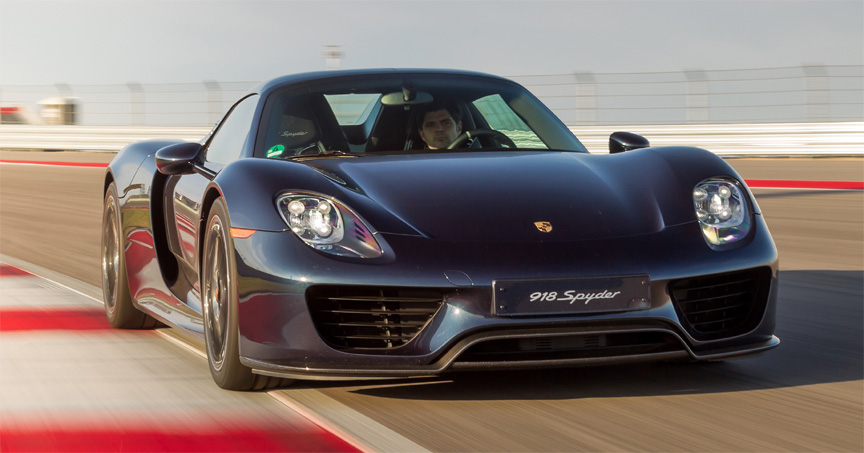 American version can be told by the front amber turn signal lenses. The full LED headlamps have the Race Light function – the faster you go the brighter they get. © Porsche
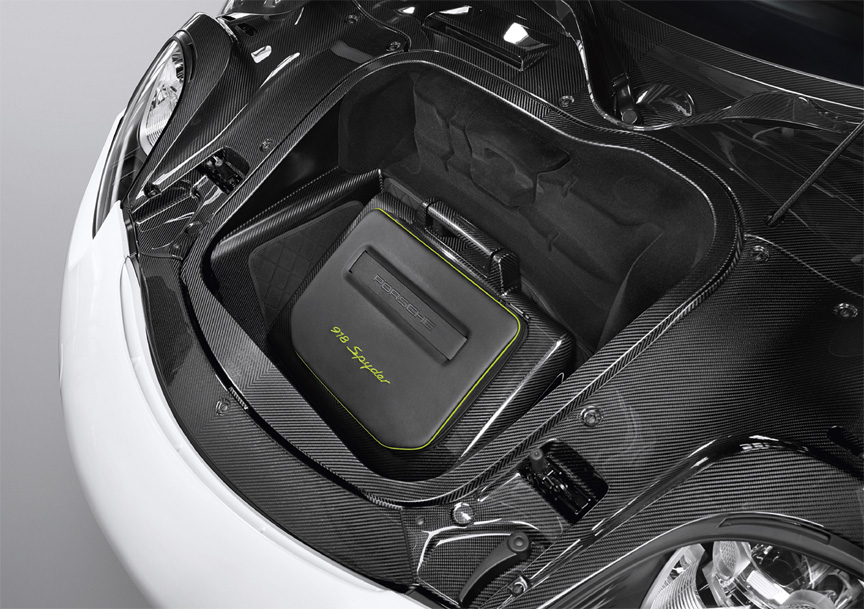 The unusual form of the specially designed trolley leaves enough space in the luggage compartment to stow the removable roof halves © Porsche
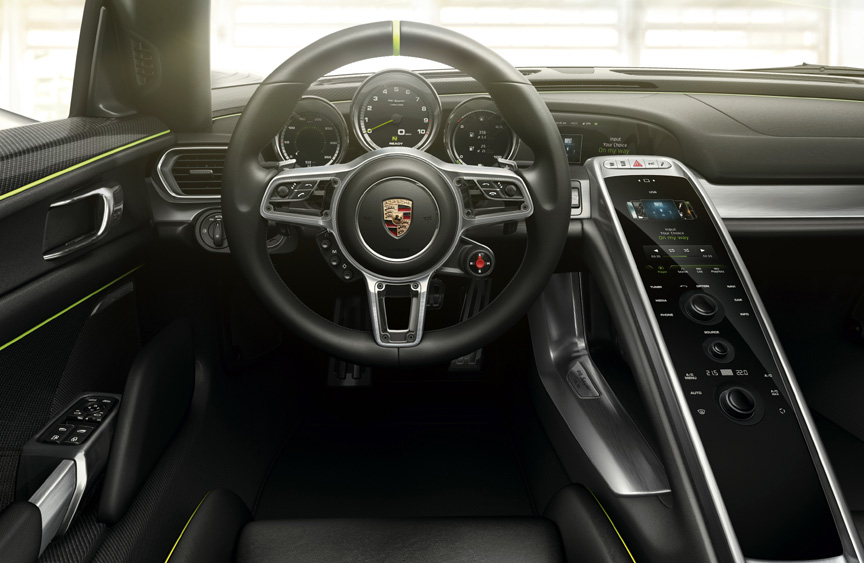 The steering wheel is only longitudinally and manually adjustable to save weight. The visual ‘aluminium’ is not real aluminium because it is too heavy, it is CFRP covered with a layer of metal – wow! © Porsche