Stuttcars.com

Ferdinand Porsche (1875-1951)

1875 September 3, Ferdinand Porsche, third of five children of Anton Porsche, was born in Maffersdorf, Reichenberg, Austro-Hungarian Empire (now Vratislavice nad Nisou, Liberec, Czech Republic).

1889-1890 at the age of 14 Ferdinand was already performing experiments with electricity. However, his father was not very impressed with this. On the contrary, for a long time he tried to forbid his son from busying himself with “such nonsense”. Therefore, Ferdinand set up his secret workshop in his parents's house. Anton Porsche was the owner of a plumbing workshop and he expected Ferdinand to take over the family business after Ferdinand's older brother died. But Ferdinand had other interests. Despite being fascinated by electricity, he completed both his plumber apprenticeship and the state trade school in Reichenberg.

One of the first known photos of Ferdinand Porsche © Porsche AG

Ferdinand’s acumen in electricity increased to such a degree that by 1893 his family home became the first in Maffersdorf to have electric light.

The house in Vratislavice, Liberec where Ferdinand Porsche was born. It is on the right bank of the Neisse and bore the number 201. © Porsche AG
Anton Porsche's house and business © Porsche AG

1893 Ferdinand began working at the electric company Bela Egger & Co. (now Brown Boveri) in Vienna. With his talent he was promoted from a worker to the test centre manager within a few years.

1897 he built an electric wheel-hub motor. In the same year he started working at Hofwagenfabrik Jacob Lohner & Co., Vienna, in the freshly established car department.

1900 The Lohner-Porsche - a vehicle powered by the Porsche electric wheel-hub motors - was celebrated as an epoch-making innovation at the world trade fair in Paris.

Lohner-Porsche was the first electric car in the world and the first front-wheel-drive car © Porsche AG

The Lohner-Porsche electric car, a "Chaise" ("Chair") with the internal vehicle number 24000, was exhibited as the only Austrian car at the 1900 Paris World Fair. A news report at the time described the development of the first-ever transmissionless vehicle as a revolutionary innovation. The electric motors in the hubs of the front wheels had an output of 1.8 kW at 120 rpm. The 44-cell, 80-volt rechargeable battery with a capacity of 300 Ah gave the car a range of 50 km / 30 miles between recharges. The maximum speed was 50 km/h / 30 mph. The slow speed of the electric motor permitted direct drive and installation in the wheel. The motor operated without chains and thus without mechanical power loss. Consequently, the electric motor was extremely efficient and was almost silent during operation. The total weight of the vehicle was 1205 kg / 2657 lbs. The car could be braked at all four wheels - by the motors at the front axle and with the aid of a mechanical strap brake at the rear axle. Ferdinand also victoriously tested his designs in races - he won on the Semmering circuit near Vienna in 1900.

1900. First 4-wheel-drive car in the world. Ferdinand Porsche sitting next to the driver of a Lohner-Porsche Electromobile. It had four 1.8 kW motors. The vehicle was intended for competition use. Ferdinand himself delivered it to the purchaser, E.W. Hart in Luton, England © Porsche AG

1902 as a reserve soldier, Ferdinand Porsche was the driver for Archduke Franz Ferdinand (whose later assassination sparked World War I). Ferdinand drove one of his own designs.

1903 Ferdinand Porsche married Aloisia Johanna Kaes

1903 Lohner-Porsche Mixte hybrid driven by F.Porsche. The car had a Daimler internal combustion engine charging the batteries that turned the electric motors in wheel hubs.© Porsche AG
1903 Ferdinand Porsche © Porsche AG

1904 daughter Louise Hedwig Anna Wilhelmine Maria Porsche (later Piëch) was born

1906 July, after eight years at Lohner, Ferdinand took up the position of Technical Director at Austro-Daimler in Wiener Neustadt. At the age of only 31, he is now responsible for the model range of one of Europe’s largest automotive companies.

1908 Mercedes-Electrique food transport vehicle. The petrol/electric vehicles with electric wheel hub drive sold from 1908 were especially popular with city dwellers. Daimler’s Marienfelde plant produced trucks, beer transporters, waste collection and other municipal vehicles, buses for city tours and, above all, fire engines. The battery-powered and later petrol/electric drive systems were developed by Ferdinand Porsche for the Lohner company who had sold the patent to Daimler. © Daimler AG

1909 September 19 son Ferdinand Anton Ernst (“Ferry”) was born. The same day Ferdinand was busy racing at Semmering (40 km from home) in an Austro-Daimler Maja engineered by him. The news about the birth of his son he got by telegram.

Austro-Daimler Maja© Porsche AG

1910 June 2-8, at the wheel of an Austro-Daimler car that he designed himself, Ferdinand won the “Prinz-Heinrich-Fahrt”, which was popular at that time. It was a long-distance test for touring cars with annually varying routes. In 1910 the race was 1945 km long (Berlin-Magdeburg-Braunschweig-Kassel-Würzburg-Nürnberg-Stuttgart-Strasbourg-Metz-Bad Homburg).

1910 Prince Heinrich Race, F.Porsche © unknown (please report if you know)
1910 Prince Heinrich Race won by F.Porsche in Austro Daimler that he had designed and piloted himself © Porsche AG
1910 Ferdinand Porsche © Porsche AG

1912-1913 F.Porsche developed the "Austro-Hungarian Electric Train" based on an idea from the Austrian Colonel General Ottokar Landwehr von Pragenau. It was subsequently renamed the "Landwehr-Train". Its design was based on the hybrid petrol-electric drive system which Ferdinand Porsche had already developed. The 6-cylinder type-M12 70kW engine drove the generator. Electricity produced by this generator was conducted to all the trailer cars throughout the train and powered the electric motors at every second axle. With the aid of the special steering system, each of the up to six trailers precisely followed the path of the motorcar. The Landwehr-Train was thus also suitable for narrow, winding roads through towns and for mountain roads. It was possible to operate the Train on railroad tracks by bolting steel discs onto the solid-rubber tyres. When used on railroad, up to ten trailers could be used.

1913 Austro-Daimler Landwehr-Train on a trial run on the Semmering road, south of Wiener Neustadt, Austria © Porsche AG
1915. Ferdinand Porsche's children, Ferry and Louise, aged 6 and 11 © Porsche AG

1917 Ferdinand became General Manager of Austro-Daimler

1922 he presented the Austro-Daimler Sascha, a small 4-cylinder racing car with a displacement of 1.1 litres. The car was designed for a wealthy Austrian count and film maker Sascha Kolowrat. At first go in the same year, “Sascha” snapped up first and second places in its category in the Targa Florio race in Sicily. "Gazetta dello Sport" commented on its success as follows: “Up until very recently no one would have dreamed it possible to achieve such top speeds and durability with a 4-cylinder engine belonging to the category of smallest cars ever.”

1922 Targa Florio. At the wheel of the Sascha is Alfred Neubauer, accompanied by his mechanic Georg Auer. Alfred Neubauer was entered for the higher-powered category with an uprated Sascha, and completed the race at an average speed only 8 km/h / 5 mph slower than these cars, which had up to four times as much power available. © Porsche AG
1922 Ferdinand Porsche © Porsche AG
ca 1922 Ries race, Graz, Steiermark © Porsche AG
ca 1922 Ries race, Graz, Steiermark. Ferry Porsche in front of his father Ferdinand Porsche. © Porsche AG
1923 Benz RH Tropfenwagen - first mid-engined racing car. Co-engineered by F.Porsche. © unknown

1923 April 30, Ferdinand joined Daimler-Motoren-Gesellschaft in Stuttgart as a technical director and an board member. Daimler and Benz companies merged the next year (and from 1926 started producing their cars under one brand - "Mercedes-Benz").

1924 April 27, Targa Florio race was won with the Mercedes PP (supercharged 2.0R4) engineered by Porsche. Two years after the sensational success of Porsche's Austro-Daimler Sascha, it was the turn of the Porsche's Mercedes racing car to take first place against larger-engined cars entered by Alfa Romeo, Hispano-Suiza and Peugeot. The PP specs were as follows: 126 hp with supercharger engaged (68 hp without it), max rpm 4500, 4-speed transmission, length 3.8 m, weight 921 kg, top speed 120 km/h. Following the win of the 1924 Targa Florio, the Stuttgart Institute of Technology (Technische Hochschule) conferred the honorary title of Dr. Ing. on Ferdinand Porsche.

1924 Targa Florio winner Christian Werner in Mercedes PP no.10. The length of the race was 432 km (4 laps of 108 km). 37 cars started. Contrary to the regulations on the colouring of racing cars according to their nationality, this car was painted red instead of white - reportedly this was meant to stop spectators from recognizing the car as a competitor's car and throwing stones at it, a common practice at the time. © unknown
1924 Ferdinand Porsche © Porsche AG
1924 Targa Florio. Mercedes PP's also came 10th driven by Christian Lautenschlager and 15th driven by Alfred Neubauer. In this photo Alfred Neubauer is at the wheel. He moved from Austro-Daimler to Daimler-Motoren-Gesellschaft in Stuttgart-Untertürkheim two months after Ferdinand Porsche and in the 1930s and 1950s he was Daimler-Benz's racing manager. © Porsche AG
1924 Targa Florio winner Christian Werner's Mercedes PP © unknown
1924 Targa Florio © unknown
1924 Targa Florio winner Mercedes PP no.10 © unknown

1924 also saw the introduction of the new racing car designed by Porsche, the Mercedes Monza.

Mercedes Monza was the first 8-cylinder Mercedes racer. It wasn't successful at the 1924 Monza race, but in 1926 won German GP. Specs: supercharged 2-litre R8, 170 hp @7000rpm, 3-speed transmission, 94L fuel tank, 780 kg / 1720 lbs, 180 km/h / 112 mph. © Daimler
Mercedes Monza on the 1924 Mercedes race car transporter. It had been Alfred Neubauer's and Christian Werner's idea not to use racing cars for the journey to the races. So, with the 1924 Monza race, it was the first time the racing cars were carried to the race and not driven there. © Daimler
© Daimler

1925 Mercedes 24/100/140 K, a heavy touring car is developed for racing purposes. Specs: supercharged 6.2L R6, 118 kW, 4-speed transmission, 110 L fuel tank, 155 km/h / 96 mph

1926 June 28, Daimler-Motoren-Gesellschaft and Benz & Cie. merge to form Daimler-Benz AG.

1926 July 11, German GP at Avus © Bundesarchiv
1926 German GP at Avus, Rudolf Caracciola wins with Porsche designed Mercedes Monza with average speed of 135 km/h / 84 mph over the 392 km / 244 mile distance (20 laps). The other Mercedes, driven by Adolf Rosenberger, crashed into the timekeepers' box killing 3 persons. In the future Rosenberger would become the founding member of the Porsche company. © Bundesarchiv
1926 German GP, Avus, Rudolf Caracciola at the wheel © unknown

1927 June 19, Mercedes-Benz 26/120/180 "S" enters the German Grand Prix (the first Nürburg-ring race) and S-model cars finish 1st, 2nd and 3rd, Caracciola taking the win.

1927 June 19, start of German GP at Nürburg-ring © unknown
Mercedes-Benz S. The S-model is based on the K-model. S has a 6.8 liter engine producing 132 kW and a top speed of 160 km/h / 100 mph. © unknown

1928 July 15 German GP at Nürburg-ring saw Mercedes-Benz 1-2-3 win. Rudolf Caracciola / Christian Werner taking the win in a Mercedes-Benz 27/140/200 "SS". This is a more powerful version of the "S" with a 7.1-liter engine producing 147 kW and with top speed of 170 km/h / 106 mph. When "S" standed for "Sports", "SS" stands for "SuperSports". In 1928 also the SSK ("SuperSports Kurz"), the short version of SS was introduced with output of 184 kW (from the same 7.1-liter) and top speed of 192 km/h / 119 mph. October 4, the Mercedes-Benz "Nürburg" 460 (18/80 hp), the first Mercedes-Benz production car with an 8-cylinder in-line engine, is launched at the Paris Motor Show. Dr.Porsche leaves Daimler-Benz at the end of the year.

1929 Dr.Porsche took up the position of Technical Manager at Steyr-Werke AG in Austria. Grandson Ernst Piėch is born.

1929 Experimental run up the Katschberg Pass, Carinthia, Austria, in a Porsche's Steyr Type 30. The car had an 8/40-hp side-valve six-cylinder engine © Porsche AG
1929. Aloisia and Ferdinand Porsche © Porsche AG

1931 April 25, at the age of 55, Ferdinand Porsche finally set up his own independent design office. It was recorded in the Commercial Register as “Dr. Ing. h. c. F. Porsche GmbH, Konstruktionen und Beratung für Motoren- und Fahrzeugbau” (Dr. Ing. h.c. F. Porsche LLC, Design and Consultancy Company for Engine and Vehicle Production). The company was co-founded by Dr. Anton Piëch (10%) and racing driver Adolf Rosenberger (10%). Already on August 10, 1931, the torsion bar suspension was registered as a patent, which would have sufficed to commemorate the Porsche name in the automobile world.

1932, May 22, AVUS race track. Ferdinand Porsche congratulating ex-Mercedes driver Rudolf Caracciola on the second position achieved with Alfa Romeo 8C Monza © Zoltan Glass, nationalmediamuseum.org.uk

1932 Porsche was contracted by Wanderer to design a 16-cylinder compressor Grand Prix racing car for the new 750-kg formula. The same year Wanderer became part of Auto Union. DKW, Audi, Horch and Wanderer all basically went to bankruptcy in 1932 and the biggest summas they owned to Bank of Saxony, which then merged all the brands into Auto Union. The P-car project was carried on now under Auto Union and the P-car (P for Porsche) later won 32 races out of 64, and drivers such as Hans Stuck and Bernd Rosemeyer set many world records in them. Granddaughter Louise Piėch (Daxer) is born in 1932. In 1932 Porsche also visited the Soviet Union at the request of Josef Stalin, who offered him a post as chief construction director, complete with generous compensation, a villa, and the transfer of his entire Stuttgart staff. He was also promised unlimited development funds to build a small car. Porsche, who still loved to race his own cars on the race tracks, declined the offer since the European Grand Prix did not extend to Communist Russia.

1933 Porsche type 32 NSU in front of the Porsche Engineering Office at Kronenstrasse 24, Stuttgart © Porsche AG

1934 a contract was concluded between the Porsche design office and the Reichsverband der Automobilindustrie - the idea of Volkswagen was born. In the following period, Ferdinand Porsche was one of the general managers of Volkswagen GmbH. Supercharged 16-cylinder Auto Union racing car (Porsche Type 22) is born. The "750-kilogram formula" imposed no restrictions on the car's design apart from a maximum weight limit of 750 kg. Despite Porsche company founder Adolf Rosenberger's contribution to the development of German automobiles and German auto racing when Hitler came to power, Rosenberger, a Jew, was arrested and forced to leave Germany. His role in the auto history was written out of history. He emigrated and represented Porsche GmbH in France and later in Great Britain.

1934 Brno GP at Masaryk-Ring, F.Porsche with Hans Stuck and Auto-Union © Porsche AG
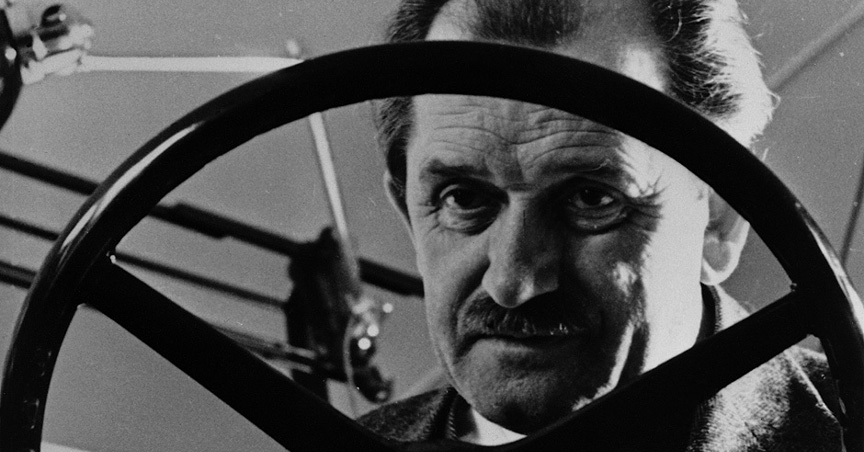
1935. Probably the most famous photo of F.Porsche © Porsche AG
1935 Nürburgring, Karusell-curve, Auto Union driven by Hans Stuck © f1-grandprixhistory.net

1935 December 11, grandson Ferdinand Alexander Porsche is born.

1936. Ferdinand Porsche with Porsche Type 22 Auto Union. © Porsche AG

1936 Received the Wilhelm Exner Medal for excellence in research and science. October 3, F.Porsche together with his nephew and private secretary Ghislaine Kaes started their voyage to USA onboard of SS Bremen. Porsche wanted to study American automobile manufacturing to gather information for the Volkswagen plant.

SS Bremen started its voyage on October 2, 1936 from Bremen. First stop was in Southampton, England (Oct.3) and the last stop before heading to Atlantic, in Cherbourg, France (Oct.3) where F.Porsche and G.Kaes stepped onboard © unknown

Passenger list from October 3, 1936, tells us that Ferdinand Porsche lived at Feuerbacherweg 48, Stuttgart, was 5'8" (172-173 cm) tall, had gray hair and blue eyes. Below is concentrated information from that list:

While for the whole world Porsche was a constructor, for the SS Bremen he had become a "conductor" © Stuttcars.com
© Ancestry.com
SS Bremen passenger list from October 3, 1936 showing Kaes Ghislaine and Porsche Ferdinand © Ancestry.com

List of prominent persons onboard of SS Bremen October 2-8, 1936: inventor and constructor Ferdinand Porsche, electrical engineer Max Knoll, aeronautical engineer Frank Caldwell, aviator William Douglas Stock Sanday, racing driver and one of the founders of Squire car company Gerard Francis Anthony "Jock" Manby-Colegrave, engineer Ernst Grob, son of bakelite inventor George Baekeland, astronomer Joseph Helffrich, architect John Russell Pope, Telefunken director Hermann Behner, industrialist Richard Merton, Prince of Sayn-Wittgenstein-Berleburg, Swedish prince Sigvard Bernadotte, novelist Johanna van Ammers-Küller, violin virtuoso and composer Fritz Kreisler, conductor, pianist and composer Wilfrid Pelletier, physicist August Karolus, industrialist Frank Vlchek, banker Rudopl Hermann Kissel, American tobacco heiress Mary French Stephenson (wife of spy William Stephenson, a role model for James Bond), screenwriter Edwin Blum ("The New Adventures of Tarzan", 1935), writer and musician Albert Morris Babgy, first American business woman and Coca-Cola board member Letitia Pate Whitehead Evans, writer Ernest Pascal, pianist Youra Guller, painter and Guggenheim Museum co-founder Hilla Rebay von Ehrenwiesen, world's biggest media magnate's wife Millicent Hearst, Broadway producer Gertrude Macy, Titanic survivor and White House music teacher Marie Grice Young and many-many others.

With about 2000 souls onboards, the ship docked in New York on October 8. Porsche visited various car factories in USA and familiarised himself with the latest production methods. He returned to Europe in November (?) on Queen Mary.

1936 New York. F.Porsche returning home aboard Queen Mary which had made her maiden voyage the same summer © Porsche AG
1936 was the year of maiden transatlantic voyage for Queen Mary and on August 1936 she already made a new world record and arrived in NYC in under 4 days © unknown

1937 April 17, grandson Ferdinand Karl Piėch is born. In June F.Porsche makes his second US visit together with his son Ferry and secretary G.Kaes. Estonian car magazine "Auto" 3/4-1937 writes: "People's car (Volkswagen) is a headache! Dr.Porsche, the constructor of the Auto-Union racing cars, said that it is easier to build 10 racing cars than 1 people's car."

1937 F.Porsche and engine specialist Josef Kales in the Porsche engineering office at Kronenstrasse 24 in Stuttgart © Porsche AG
1937. Ferdinand Porsche with his son Ferdinand Anton Ernst "Ferry" Porsche © Porsche AG
1937. Ferdinand Porsche seen with a car from the W30 series of Volkswagen prototypes. This car already had an all-steel body, steel running-gear components and the flat-four four-stroke engine. The first of this series of cars, like all the previous prototypes, was built in the double garage of Porsche's villa in Stuttgart; the remaining 29 cars were built by Daimler-Benz in Stuttgart-Untertürkheim © Porsche AG

In 1937 the German Armaments Ministry issued a specification for a heavy tank to Daimler-Benz, Henschel, MAN and Porsche. The same year also the Mercedes-Benz T80 land speed record car (Porsche Type 80) project was started backed by Hitler's money, Dr.Porsche's ingenious ideas, aerodynamics specialist Josef Mikcl and driver Hans Stuck. Porsche first targeted a speed of 550 km/h / 342 mph, but later the target was rised.

1937-1938 Ferdinand Porsche at the age of 62 in his design office located at Kronenstraße 24, Stuttgart. © Porsche AG

1938 January. Although Adolf Hitler discussed with Ferdinand Porsche the possibility of military application of the Volkswagen as early as April 1934, it wasn't until now that high-ranking Third Reich army officials formally approached Porsche about designing an inexpensive, light-weight military transport vehicle that could be operated reliably both on- and off-road in even the most extreme conditions, suggesting that the Beetle could provide the basis for such a vehicle. In May 1938 VW Kübelwagen prototype construction started (and in 1.5 years pre-production models were field-tested in the invasion of Poland that started in September 1939). Grandson Gerhard Anton Porsche is born in 1938. Estonian "Auto" magazine 5/1938 writes that the KdF-wagen factory construction started in May 1938 and after it will be finished, 50.000 workers will be hired. The article writes that no other car in the world has passed so many and so long tests as Dr.Porsche's people's car. Initial information says, the car will weigh only 650 kg, will consume 6-7 litres of fuel on 100 km and standard color will be dark blue!? Acceleration 0-70 km/h comes in 14 seconds which is comparable to the cars with larger engines.

Robert Ley (head of KdF), Ferdinand Porsche and Adolf Hitler driven by Ferry Porsche. The persons sitting on the right seem happy and the persons sitting on the left - not. Porsche got money from Hitler to build the racing cars and the Beetle, but now he "had to" design also the military equipment. © unknown

1939 September was scheduled for the Berlin-Rome race that never happened due to the outbreak of WWII, but Porsche had already engineered and built a type 60K10/type 64 racing car. Three Type 64 coupes were made.

© unknown
Type 64 with blackout masks on the headlights. They served as high-speed transport during the war for Ferdinand Porsche and others. Porsche 64 is the grandfather of all Porsche sports cars to come. © unknown

By late 1939 the Mercedes/Porsche land speed record car T80 was also finished - now with the targeted top speed of 750 km/h / 466mph - but also didn't see its record attempt scheduled for January 1940 due to the outbreak of the war. If the record attempt would have actually happened, Hans Stuck would have most probably died in January 1940 (and not in February 1978). A part of Berlin-Dessau autobahn was planned to use and it was only 25-27 m / 83-90 feet wide - imagine that at the projected top speed!

T80 had a tuned Daimler-Benz aircraft engine. The inverted V12 (crank up, cylinders down) with 44 liters displacement developed 3000 hp. The engine ran on a mixture of 7 different chemicals. The streamlined body achieved a drag coefficient of an astonishing 0.18. Kurb weight: 2900 kg / 6393 lbs. © unknown
In 1939 the projected top speed was risen to 750 km/h! How would you feel if you were the guy in the cockpit? No car in the world with piston engine and wheel drive has ever reached 750 km/h. © unknown
The DB-603 aircraft engine was removed during the war while the vehicle was moved to safe storage in Kärnten, Austria (where Porsche had moved its company because of the war). T80 survived the war and is now displayed in Mercedes-Benz Museum in Stuttgart. © unknown

1940 October 29 grandson Hans-Peter Porsche is born. Same year Ferdinand Porsche was conferred the honorary title of professor.

1940-1945 a total 50.435 Porsche designed VW Kübelwagens were made. Photo taken in 1943 in Russia © Bundesarchiv

1941 May 26 Hitler ordered both Porsche and Henschel to supply their designs for a heavy tank. The project was known as the "Tigerprogram".

1941-1944 a total of 15.584 Type 166 Porsche designed VW Schwimmwagens were produced; 14.276 at Volkswagen factory and 1308 by Porsche. © Porsche AG
ca 1942. Ferdinand Porsche, grandson Ernst Piëch, granddaughter Louise Piëch, daughter Louise Piëch-Porsche. Sitting on the grass on the left: Ferdinand Piëch© Porsche AG

1942 grandson Hans-Michel Piėch is born.

Dr.Porsche and Tiger (P) - "P" for Porsche © unknown
100 tanks Tiger (P) were ordered, but the order was cancelled in the beginning of the production and only a few were made. Only one Tiger P saw real war action in 1944. Over 1000 Tiger (H) - "H" for Henschel - were made between 1942-1944. F.Porsche can be seen on the photo. © unknown

1943 May 10 grandson Wolfgang Porsche is born. The Porsche heavy tank destroyer Tiger P Elefant went into production. They were originally built under the name Ferdinand, after their designer. Around 90 tank hulls that were left unused after the Tiger P tank production was terminated, were now built into Elefants.

Destroyed Elefant. Photo taken in 1944 in Italy. © Bundesarchiv

1944 autumn, Porsche design office was relocated 600 km from Stuttgart to Gmünd in Carinthia (Gmünd in Kärnten), Austria. Ferdinand Porsche lived in Gmünd and Zell am See towards the end of the war.

Porsche type 205 Panzerkampfwagen VIII "Maus" was a German WWII super-heavy tank completed in late 1944. With the weight of 188 tons it is the heaviest fully enclosed armoured fighting vehicle ever built. Two prototypes were built, one of them functional which got hit in the war. After that Soviets merged the base from one tank and the top from the other and this new creation was taken to Russia where it is now in a tank museum. © unknown

1945 September 2, World War II ended. December 15 Ferdinand Porsche, Ferry Porsche and Anton Piëch were suddenly arrested at the meeting for discussion of French people's car. All three were put to jail.

1946 July. Ferry was released to bring money to bail out his father. During Dr.Porsche's captivity at the medieval jail of Dijon, he was forced to collaborate on designs for Renault 4CV. The terrible conditions of the Dijon jail harmed his health seriously.

1947 August 1 Ferdinand Porsche and Anton Piëch are liberated after Ferry Porsche had paid the asked summa. Upon Dr.Porsche's return he examined the design of the Cisitalia racing car, which was constructed under the management of his son and which brought the money for the bail. After close observation, he came to the conclusion: “I would have built it exactly the same way, right down to the last screw”. French court later found F.Porsche not quilty for the war crimes but the money wasn't returned.

1948 June 8, first Porsche 356 is road registered. 356 no.1 was a mid-engined tubular steel frame roadster with aerodynamic aluminium body constructed by Dr.Porsche's son Ferry Porsche. Only one month later, the lightweight mid-engined roadster scores its first class victory at the Innsbruck Stadtrennen.

1948 Gmünd, Carinthia, Austria. Exterior designer Erwin Komenda, Ferry Porsche, Ferdinand Porsche, 356 no.1 (35 hp, 585 kg / 1290 lbs, 135 km/h / 84 mph). © Porsche AG
1949. F.Porsche with his grandchildren Ferdinand Alexander "Butzi" Porsche (left) and Ferdinand Piėch (right). Both young boys were to become serious players in the future. © Porsche AG

1950 April 6, the first Porsche 356 is produced in the new factory in Stuttgart. 369 cars are made in 1950.

1950 Porsche office, Zuffenhausen, Stuttgart. From left: engine constructor Leopold Jäntschke, Ferry Porsche, Ferdinand Porsche, Emil Soukup © Porsche AG
1950 Porsche office, Zuffenhausen, Stuttgart. From left: engine constructor Leopold Jäntschke, Ferdinand Porsche, Ferry Porsche. © Porsche AG
1950. Ferdinand Porsche standing next to the 356 "Gmünd Coupé" with his son Ferry Porsche at the wheel. Behind the car is the double garage of Porsche's villa in Stuttgart, in which the first Volkswagen prototypes were built © Porsche AG
1950. Ferdinand Porsche with Karl Rabe, who was Porsche's chief designer from the establishment of the Porsche company in 1931 until his retirement at the end of 1965. Rabe worked for Austro-Daimler with Ferdinand Porsche from 1913 on, where he became design office manager in 1923 after Porsche's move to Daimler-Motoren-Gesellschaft. In 1929, when Ferdinand Porsche joined the Steyr-Werke, he encountered Karl Rabe, again, who had been deputy head of design there since 1927. From then on, the careers of Karl Rabe and Ferdinand Porsche remained closely linked © Porsche AG
1950 September 3, 30 356 owners gathered in Stuttgart to greet Dr.Porsche on his 75th birthday© Porsche AG
1950. Portrait of Ferdinand Porsche, taken to celebrate his 75th birthday, with his signature below. © Porsche AG
1950. Ferdinand Porsche's last visit to the factory© Porsche AG
1950. Last photo of Ferdinand Porsche© Porsche AG

1951 January 30, at the age of 75 Professor Dr. Ing. h.c. Ferdinand Porsche dies in Stuttgart. He didn't recover from the stroke he got in November 1950. He is laid to rest in chapel in family estate "Schüttgut" in Zell am See, Austria.

1.50 schilling stamp issued in Austria on F.Porsche's 100th birthday anniversaryO.Stefferl/A.Fischer 

© James Herne / Stuttcars.com


Next chapter: son Ferry Porsche